 Bug FAQ
Red Helen Swallowtail
Papilio helenus · Order: Lepidoptera · Family: Papilionidae
Also called: Red Helen
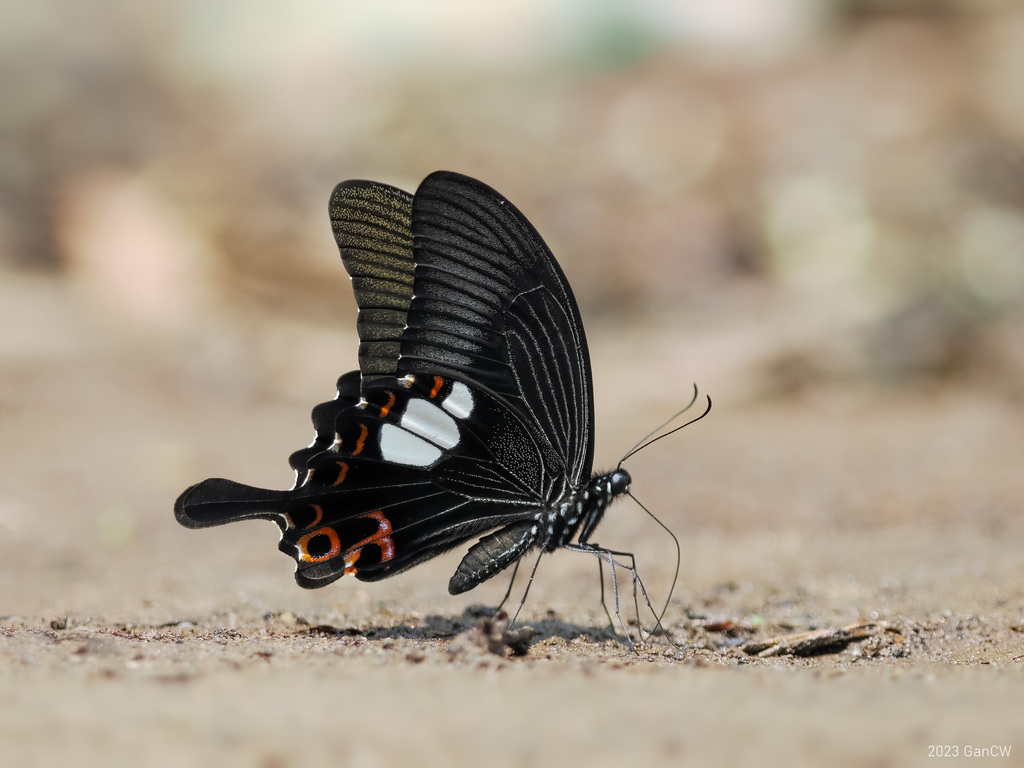
The red Helen swallowtail is a large butterfly that lives in forested areas of southern India and much of southeast Asia. Males have a dark brown-black upper side with white-tipped wing edges and golden-yellow streaks on the fore-wing. Eggs are laid singly on young leaf tips in shady jungle, the eggs hatch in about a week, and adults can be seen flying all year in southern India.
Source: Wikipedia
How to recognize it
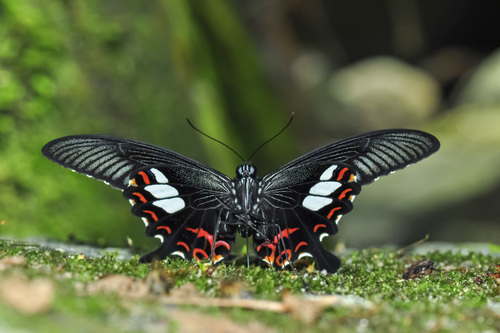
Males show a dark brown-black upper side with alternating white and dark cilia on the wing edges. The fore-wing has thin golden-yellow streaks inside the cell and broader hairy-scaled streaks between the outer veins, with some yellow speckles near the wing base.
Source: Wikipedia
Size
It is a large swallowtail butterfly.
Source: Wikipedia
Where it lives
It inhabits forests in southern India and parts of southeast Asia.
Source: Wikipedia
Life cycle
The egg hatches in four to seven days.
Source: Wikipedia
When you see it
Adults are on the wing throughout the year in southern India.
Source: Wikipedia
Where it comes from
Its range includes Sri Lanka, India, Nepal, Bhutan, Bangladesh, Myanmar, Thailand, Laos, Cambodia, Vietnam, southern China, Taiwan, southern Japan, South Korea, the Ryukyu Islands, Malaysia, Brunei, the Philippines, and Indonesia.
Source: Wikipedia
Lookalikes
Other members of the helenus species group that look similar are Papilio iswara, Papilio iswaroides, Papilio nephelus, Papilio nubilus, and Papilio sataspes.
Source: Wikipedia
Where it is found in the US
Recorded in 1 of 51 states and DC. Most records: California.
Darker = more records. Counts are museum and citizen-science records, not population size.
Source: GBIF
More photos
Same family (Papilionidae)

Sources
- Wikipedia: https://en.wikipedia.org/wiki/Papilio_helenus
Look it up elsewhere: GBIF · iNaturalist · BugGuide · Wikipedia
Text written 2026-10-22 from the sources above and checked sentence by sentence against them. Data fetched 2026-10-22.