 Bug FAQ
Red-headed Paper Wasp
Polistes erythrocephalus · Order: Hymenoptera · Family: Eumenidae
Source: Wikipedia

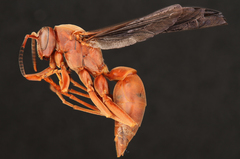
The red-headed paper wasp is about 21 mm long and has a rust-colored head with a plain black thorax and a slightly shinier abdomen. It builds open but protected nests in both human-made and wild sites across Central and South America and feeds on various insect larvae, especially hornworms. If a person approaches its nest within 1 to 2 m, the wasp will attack and sting.
Source: Wikipedia
Size
Adults are about 21 mm (0.83 in) long.
Source: Wikipedia
What it eats
These wasps are predators that eat many kinds of insect larvae. They commonly prey on hornworm larvae, averaging about half a larva per day.
Source: Wikipedia
Life cycle
Their life cycle lasts about 110 days, ranging from 91 to 131 days. They develop through the usual Polistes stages: egg, larva, pupa, and adult.
Source: Wikipedia
Where it comes from
They are native to Central and South America.
Source: Wikipedia
Lookalikes
They were once thought to be a subspecies of P. canadensis, but unlike that species, P. canadensis has a rust-colored thorax, abdomen, and head.
Source: Wikipedia
More photos

Questions people ask
Do they sting people?
Yes, they will sting if you get within about two meters of their nest.
Source: Wikipedia
What do they look like?
They have a dull rust-colored head, an unmarked black thorax, and a slightly shinier black abdomen.
Source: Wikipedia
Where are they found?
They are native to Central and South America and build nests in open, protected spots near humans or in the wild.
Source: Wikipedia
Same family (Eumenidae)



Sources
- Wikipedia: https://en.wikipedia.org/wiki/Polistes_erythrocephalus
Look it up elsewhere: GBIF · iNaturalist · BugGuide · Wikipedia
Text written 2026-10-23 from the sources above and checked sentence by sentence against them. Data fetched 2026-10-23.