 Bug FAQ
Pseudodynerus quadrisectus
Pseudodynerus quadrisectus · Order: Hymenoptera · Family: Eumenidae
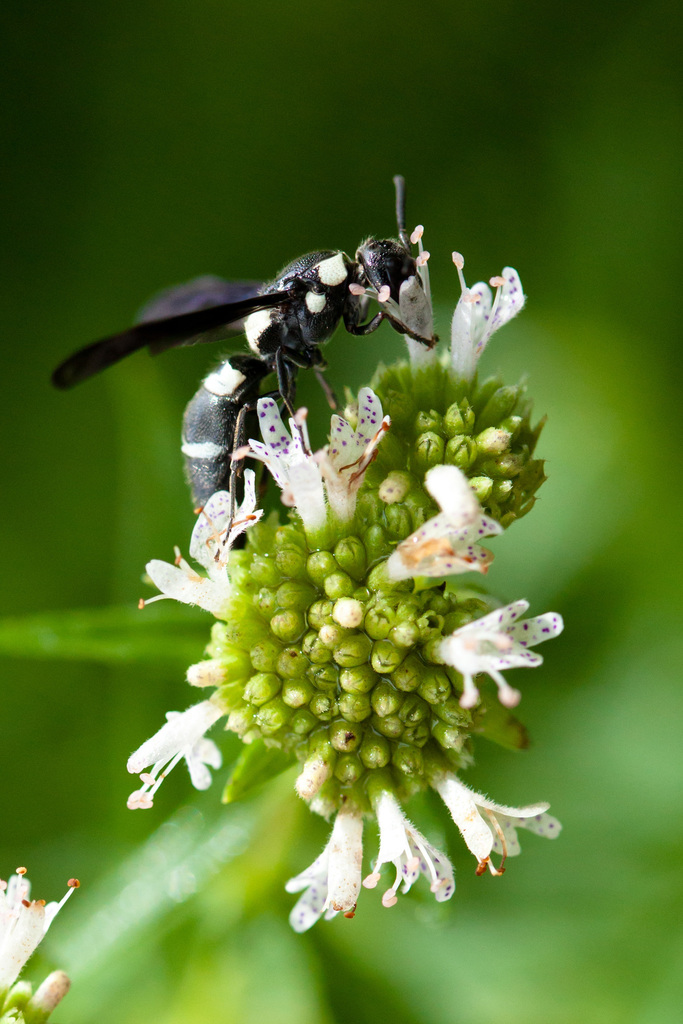
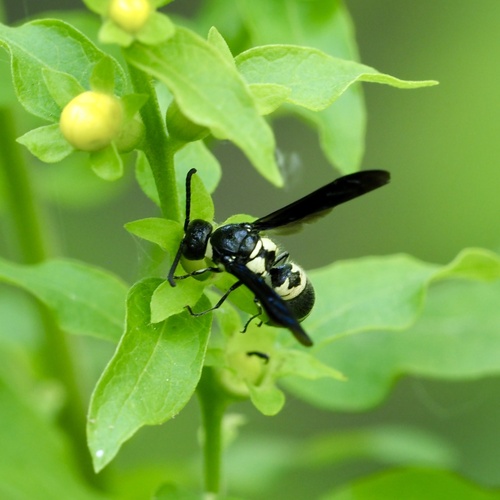
Pseudodynerus quadrisectus is a medium to large wasp with forewings about 12 to 16 mm long in females and 10.5 to 13 mm in males. It is mostly black with ivory markings that are especially noticeable on females.
Source: Wikipedia
How to recognize it
The wasp’s body is primarily black with ivory-colored markings that stand out more on females.
Source: Wikipedia
Size
Females have forewing lengths of 12 to 16 mm, while males measure 10.5 to 13 mm.
Source: Wikipedia
Where it lives
It builds mud nests in pre-existing wood holes, often using cavities previously made by other insects such as carpenter bees.
Source: Wikipedia
What it eats
Adults provision each nest chamber with captured insects for the developing larvae.
Source: Wikipedia
Life cycle
Females construct mud-lined chambers, stock them with insect prey, and seal them for the larvae to develop.
Source: Wikipedia
Where it comes from
The species occurs in the United States from New Jersey to Florida and west to Texas, and is also found in Mexico and Costa Rica.
Source: Wikipedia
Where it is found in the US
Recorded in 32 of 51 states and DC. Most records: Ohio, Virginia, Pennsylvania, Florida, Texas, Maryland, New York, Missouri.
Darker = more records. Counts are museum and citizen-science records, not population size.
Source: GBIF
Months it is reported in the US
Source: GBIF
More photos
Questions people ask
How can I recognize Pseudodynerus quadrisectus?
Look for a medium-large black wasp with ivory markings, especially on females, and forewings about 12 to 16 mm long in females or 10.5 to 13 mm in males.
Source: Wikipedia
Where might I find this wasp?
It lives in the eastern and southern United States, Mexico, and Costa Rica, nesting in wood cavities that it lines with mud.
Source: Wikipedia
What does this wasp feed its larvae?
The female captures insects and places them in each mud-lined nest chamber for the larvae to eat.
Source: Wikipedia
Same family (Eumenidae)

Sources
- Wikipedia: https://en.wikipedia.org/wiki/Pseudodynerus_quadrisectus
Look it up elsewhere: GBIF · iNaturalist · BugGuide · Wikipedia
Text written 2026-10-23 from the sources above and checked sentence by sentence against them. Data fetched 2026-10-22.