 Bug FAQ
Prickly Stick Insect
Acanthoxyla prasina · Order: Phasmida · Family: Phasmatidae
Also called: Black-spined Stick Insect
Source: Wikipedia

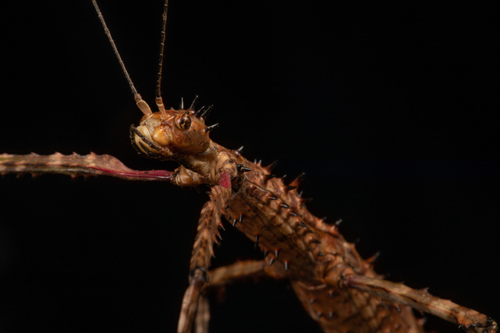
Adult prickly stick insects are 7.5 to 11 cm long and often have dark spines on their bodies. They live throughout New Zealand in both native and modified habitats and are active at night. They feed on a wide range of native and introduced plants, including garden shrubs and conifers, and can become a pest of garden vegetation.
Source: Wikipedia
Size
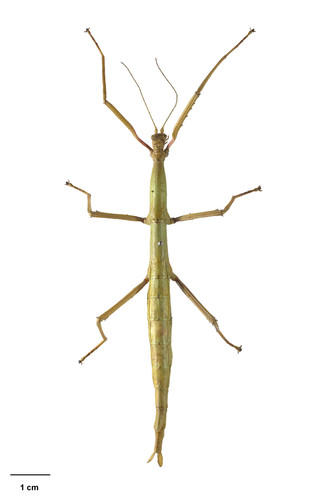
Adults measure between 7.5 and 11 cm in body length.
Source: Wikipedia
Where it lives
It occurs throughout New Zealand but is seen less often than more common stick insects. It lives in both native and modified environments across the country.
Source: Wikipedia
What it eats
It is a generalist feeder that eats many native and introduced plants.
Source: Wikipedia
Life cycle
All individuals are females and reproduce asexually by parthenogenesis.
Source: Wikipedia
When you see it
The insect is nocturnal and mainly feeds at night.
Source: Wikipedia
Where it comes from
The species is endemic to New Zealand.
Source: Wikipedia
Lookalikes
It is sometimes mistaken for other Acanthoxyla subspecies or for the smooth stick insect Clitarchus hookeri.
Source: Wikipedia
More photos
Questions people ask
Is the prickly stick insect active during the day?
No, it is nocturnal and mainly feeds at night.
Source: Wikipedia
How can I tell this stick insect apart from similar species?
Look for its broader body, green or brown coloration, and the dark spines with black tips on the head, thorax, abdomen and femora; the last abdominal segment is also shorter and more rounded.
Source: Wikipedia
Same family (Phasmatidae)


Sources
- Wikipedia: https://en.wikipedia.org/wiki/Acanthoxyla_prasina
Look it up elsewhere: GBIF · iNaturalist · BugGuide · Wikipedia
Text written 2026-10-23 from the sources above and checked sentence by sentence against them. Data fetched 2026-10-22.