 Bug FAQ
Potato Stalk Borer
Trichobaris trinotata · Order: Coleoptera · Family: Curculionidae
Source: Wikipedia
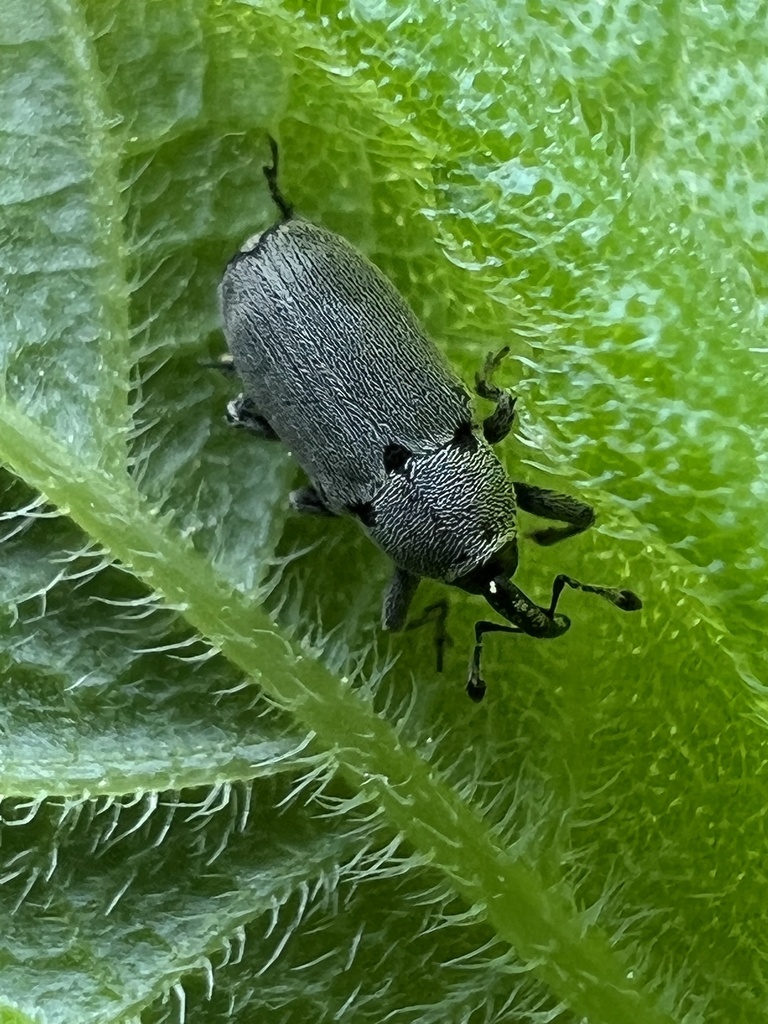
The adult potato stalk borer is a tiny black weevil about 4.4 mm long, covered in gray scales except for three bare spots on its back. Adults emerge in spring, lay eggs in May, and the larvae tunnel up to 30 cm through potato stems before pupating and emerging as new adults later in the season.
Source: Wikipedia
How to recognize it
The weevil is black with a gray-scaled surface, but the head and three small spots at the base of the wing covers are bare and appear dark.
Source: Wikipedia
Size
Adults measure about 4.4 mm in length and 1.7 mm in width.
Source: Wikipedia
Is it a pest in the house?
Adults chew ragged holes in leaves, but the larvae cause the most damage by tunnelling inside potato stems.
Source: Wikipedia
How to get rid of it
- Burning or removing crop residues destroys overwintering adults.
- Modern management practices have reduced its impact compared with earlier times when it was a serious potato pest.
Source: Wikipedia
Where it lives
It lives in North America where it infests potato plants, with larvae boring inside the stems. Adults spend the winter inside dead potato stalks or the stems of other Solanaceae such as Carolina horsenettle.
Source: Wikipedia
What it eats
Both adults and larvae feed on members of the nightshade family, especially potatoes, but also eggplant, Carolina horsenettle, buffalo bur, European black nightshade, and groundcherries.
Source: Wikipedia
Life cycle
Adults break diapause in spring and females begin laying eggs in May. Eggs hatch in about a week; the legless larvae chew tunnels up to 30 cm long through stem tissue. After five or six larval stages lasting up to 106 days, they pupate in the stem and emerge as adults roughly twelve days later. There is one generation per year.
Source: Wikipedia
When you see it
Adults become active in spring and start egg-laying in May.
Source: Wikipedia
Where it comes from
The species is native to North America.
Source: Wikipedia
Where it is found in the US
Recorded in 22 of 51 states and DC. Most records: Mississippi, Illinois, Kansas, Pennsylvania, Virginia, California, Colorado, Alabama.
Darker = more records. Counts are museum and citizen-science records, not population size.
Source: GBIF
Status: native in North America; native in Canada. Source: iNaturalist
Months it is reported in the US
Source: GBIF
Questions people ask
How can I control potato stalk borer?
Destroying crop residues by burning or removal eliminates the overwintering adults, and current management practices keep the pest at low levels.
Source: Wikipedia
When are adult potato stalk borers active?
Adults emerge from diapause in spring and begin laying eggs in May.
Source: Wikipedia
What plants does the potato stalk borer damage?
It feeds on potatoes and can also damage eggplant, Carolina horsenettle, buffalo bur, European black nightshade, and groundcherry species.
Source: Wikipedia
What does the potato stalk borer look like?
It is a small black weevil about 4.4 mm long, covered in gray scales except for three bare dark spots at the base of its wing covers.
Source: Wikipedia
Same family (Curculionidae)
 Green Immigrant Leaf WeevilPolydrusus formosusDamages trees, gardens or crops
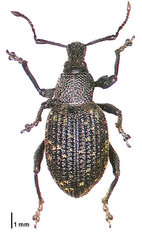 Black Vine WeevilOtiorhynchus sulcatusDamages trees, gardens or crops
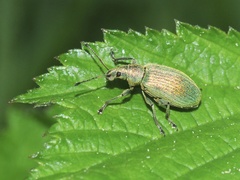 Nettle weevilPhyllobius pomaceusDamages trees, gardens or crops
 Asian Oak WeevilCyrtepistomus castaneusDamages trees, gardens or crops
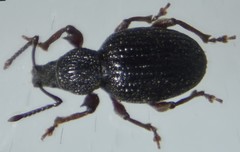 Strawberry Root WeevilOtiorhynchus ovatusDamages trees, gardens or crops
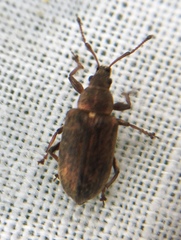 Common Leaf WeevilPhyllobius pyriDamages trees, gardens or crops
Sources
- Wikipedia: https://en.wikipedia.org/wiki/Trichobaris_trinotata
Look it up elsewhere: GBIF · iNaturalist · BugGuide · ITIS · Wikipedia
Text written 2026-10-28 from the sources above and checked sentence by sentence against them. Data fetched 2026-10-28.