 Bug FAQ
Pond Amberwing
Perithemis mooma · Order: Odonata · Family: Libellulidae
Also called: Eastern Amberwing

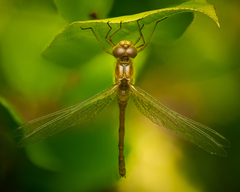
The pond amberwing is a very small dragonfly, reaching no more than about 25 mm in length. Males have orange-amber wings while both sexes show a red pterostigma. It lives in eastern North America, from northern Mexico up to southeastern Canada.
Source: Wikipedia
How to recognize it
Males display orange or amber wings, likely due to pheomelanin. Both males and females have a red pterostigma on their wings.
Source: Wikipedia
Size
The species is very small, never longer than about 25 mm (0.98 in).
Source: Wikipedia
Where it comes from
Its native range covers eastern North America, from northern Mexico up to southeastern Canada.
Source: Wikipedia
Lookalikes
The eastern amberwing dragonfly actively mimics a wasp.
Source: Wikipedia
Where it is found in the US
Recorded in 43 of 51 states and DC. Most records: Ohio, Texas, Florida, New Jersey, Virginia, Illinois, Maryland, New York.
Darker = more records. Counts are museum and citizen-science records, not population size.
Source: GBIF
Months it is reported in the US
Source: GBIF
Questions people ask
What does the pond amberwing look like?
Males have orange-amber wings and both sexes have a red pterostigma.
Source: Wikipedia
Where can I find pond amberwings?
They occur in eastern North America, from northern Mexico up to southeastern Canada.
Source: Wikipedia
How big are pond amberwings?
They are very small, never exceeding about 25 mm in length.
Source: Wikipedia
Same family (Libellulidae)


Sources
- Wikipedia: https://en.wikipedia.org/wiki/Eastern_amberwing
Look it up elsewhere: GBIF · iNaturalist · BugGuide · ITIS · Wikipedia
Text written 2026-10-23 from the sources above and checked sentence by sentence against them. Data fetched 2026-10-23.