 Bug FAQ
Polistes nimpha
Polistes nimpha · Order: Hymenoptera · Family: Eumenidae
Source: Wikipedia
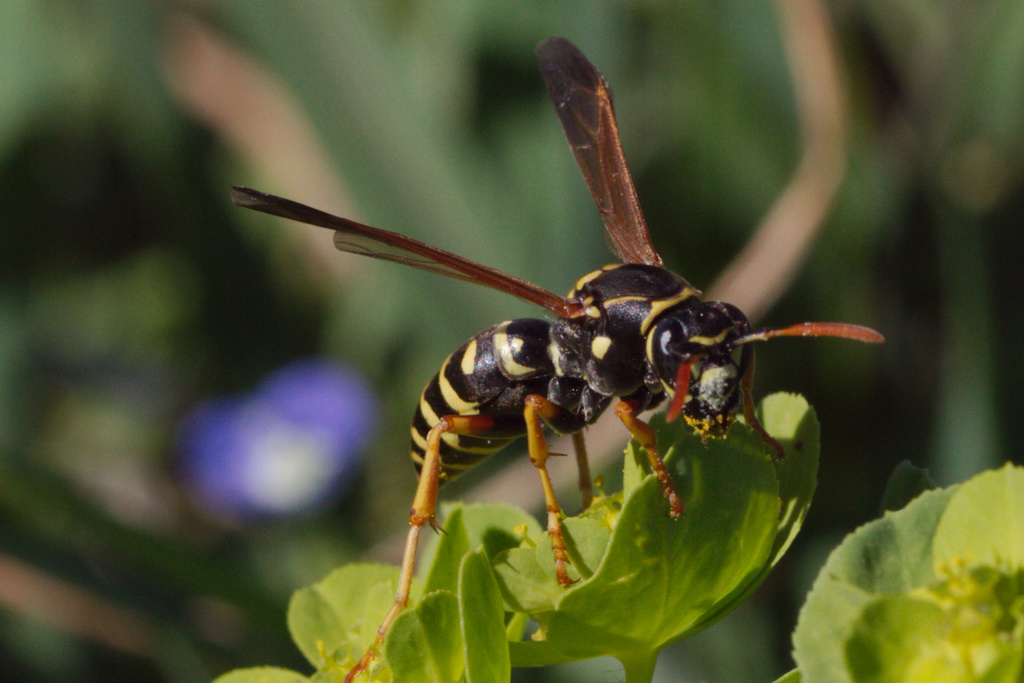
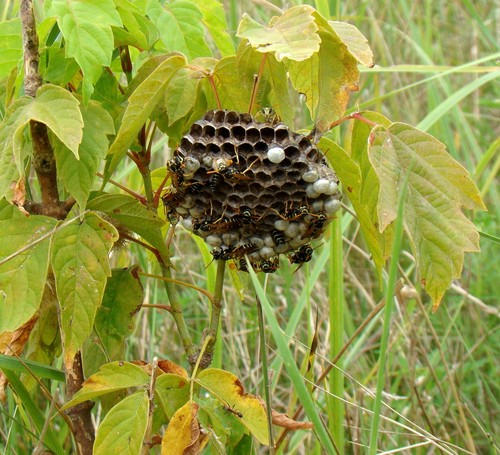
These paper wasps build papery nests on plants, under eaves, or in sheltered spots in warm, low-lying open land. Females have a yellow malar area and a mostly black sixth gastral sternum; males show ridged clypeus and distinct antennal proportions. They are found across Europe, parts of Asia, and northern Africa, and they use plant fibers mixed with oral secretions to make their nests.
Source: Wikipedia
How to recognize it
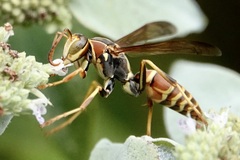
Female Polistes nimpha have a yellow area between the mandible and eye and a black sixth gastral sternum, sometimes with a tiny yellow spot. Male Polistes nimpha have a clypeus with side ridges and the last antennal segment is 2.2 to 2.9 × as long as wide and 1.3 to 1.5 × as long as the fifth segment.
Source: Wikipedia
Does it bite or sting?
The venom gland has an oval muscular sac, and the stinger tip curves toward the middle with short palps.
Source: Wikipedia
Where it lives
They prefer warm, low, uncultivated areas and usually nest on plants, under roof eaves, or in other closed spaces.
Source: Wikipedia
What it eats
They make nest paper from plant fibers collected near the nest, mixed with their oral secretions.
Source: Wikipedia
Life cycle
Researchers have found two phenotypically distinct groups of females; infested females are smaller and lighter on the mesoscutum.
Source: Wikipedia
When you see it
In late summer, males patrol small territories around hedges and bushes, attacking intruders by biting the head and legs.
Source: Wikipedia
Where it comes from
Polistes nimpha occurs throughout Europe, including Turkey, Finland, Estonia, and Latvia, and also in northern Africa, Pakistan, Iran, India, Kazakhstan, Mongolia, and China.
Source: Wikipedia
Lookalikes
Polistes nimpha is generally darker than Polistes dominula, but females of nimpha, dominula, and associus are hard to tell apart.
Source: Wikipedia
More photos
Questions people ask
Do Polistes nimpha sting?
Yes, they have a stinger with a venom sac and can deliver a mild sting.
Source: Wikipedia
Where do they build their nests?
They usually attach nests to plants, under eaves, or in sheltered spots in warm, open land.
Source: Wikipedia
How can I tell a female Polistes nimpha from similar wasps?
Look for a yellow area between the mandible and eye and a mostly black sixth gastral sternum.
Source: Wikipedia
What region are Polistes nimpha native to?
They are found across Europe, northern Africa, and parts of Asia including Pakistan, Iran, India, Kazakhstan, Mongolia, and China.
Source: Wikipedia
Same family (Eumenidae)

Sources
- Wikipedia: https://en.wikipedia.org/wiki/Polistes_nimpha
Look it up elsewhere: GBIF · iNaturalist · BugGuide · Wikipedia
Text written 2026-10-22 from the sources above and checked sentence by sentence against them. Data fetched 2026-10-22.