 Bug FAQ
Plain Tiger Butterfly
Danaus chrysippus · Order: Lepidoptera · Family: Nymphalidae
Also called: Common Milkweed Butterfly, African Monarch, African Plain Tiger, African Queen
It lives in dry open areas such as deserts, mountains, forests and gardens, from sea level up to roughly 1,500 m, and is found across Africa, much of Asia, many Pacific islands and parts of Australia.
Source: Wikipedia
How to recognize it
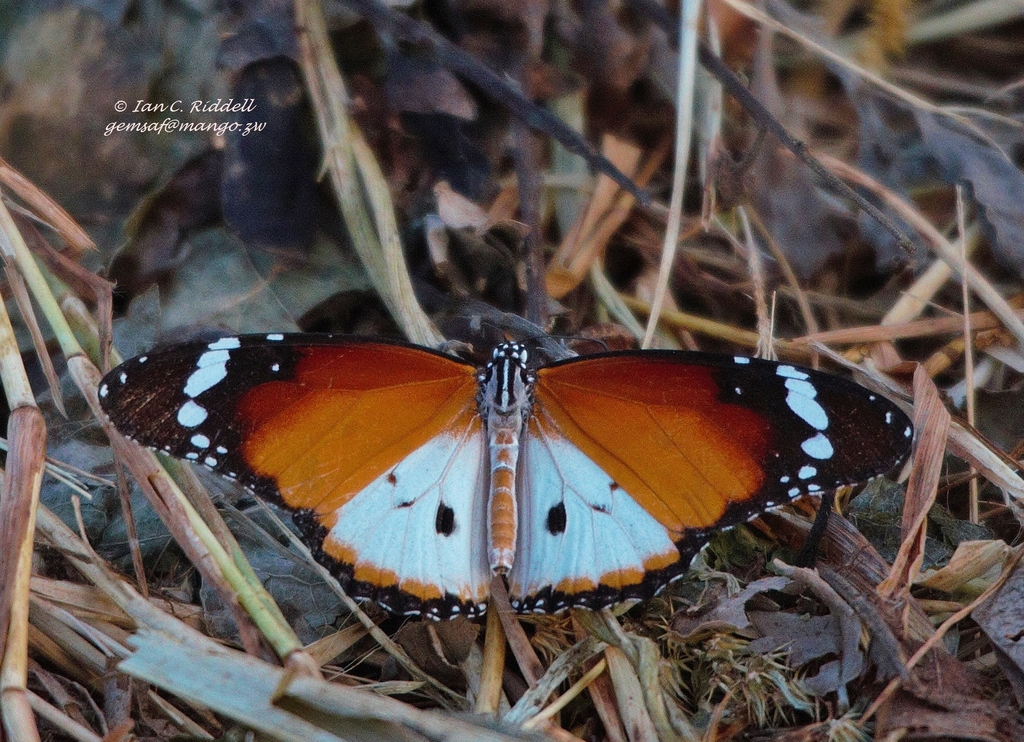
The body is black with white spots. The wings are brown-orange, brighter on the upper side. The front wing’s outer half is black with a white band. The hindwing has three central black spots. All wings have black borders edged with semicircular white spots.
Source: Wikipedia
Size
Wingspan ranges from about 7 to 8 cm (2.8 to 3.1 in).
Source: Wikipedia
Where it lives
Prefers arid, open habitats and can be found in deserts, mountains, deciduous forests and city gardens. Occurs from sea level up to roughly 1,500 m (4,900 ft).
Source: Wikipedia
What it eats
Larvae feed on plants in the milkweed family (Asclepiadoideae, Apocynaceae). Adults, like other Danainae, commonly visit milkweed flowers.
Source: Wikipedia
Where it comes from
Found throughout Africa, especially the subspecies D. c. alcippus. Its range extends across most of Asia, including the Indian subcontinent, and many South Pacific islands. It is also present in parts of Australia.
Source: Wikipedia
Lookalikes
It looks similar to the Indian fritillary (Argynnis hyperbius).
Source: Wikipedia
Where it is found in the US
Recorded in 1 of 51 states and DC. Most records: Texas.
Darker = more records. Counts are museum and citizen-science records, not population size.
Source: GBIF
Same family (Nymphalidae)






Sources
- Wikipedia: https://en.wikipedia.org/wiki/Danaus_chrysippus
Look it up elsewhere: GBIF · iNaturalist · BugGuide · Wikipedia
Text written 2026-10-22 from the sources above and checked sentence by sentence against them. Data fetched 2026-10-22.