 Bug FAQ
Peruvian Shield Mantis
Choeradodis rhombicollis · Order: Mantodea · Family: Mantidae

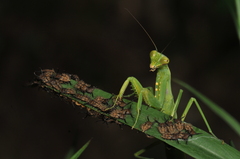
The Peruvian shield mantis is bright green on top and lighter underneath, with dark-green raptorial claws that have golden interiors. It hides by looking like a leaf and waits motionlessly to catch insects, but larger adults can also eat lizards and hummingbirds.
Source: Wikipedia
How to recognize it
Its body is various shades of green, lighter on the belly, and the outer wings cover translucent inner wings for camouflage. The front claws are dark green with golden coloring inside the coxa, femur, and tibia.
Source: Wikipedia
Where it lives
It resembles both living and dead leaves. It positions itself next to a leaf that it looks like.
Source: Wikipedia
What it eats
It uses a sit-and-wait strategy to catch a wide range of arthropods. Larger individuals have been seen catching and eating lizards and even hummingbirds.
Source: Wikipedia
Life cycle
Females lay an ootheca containing 30-50 eggs from which the nymphs hatch.
Source: Wikipedia
When you see it
After the wet season, around September, they mate, copulate, and lay eggs a few days later.
Source: Wikipedia
Lookalikes
Its prothorax is widened into a leaf-shaped hood, similar to related shield mantises.
Source: Wikipedia
Status: native in North America. Source: iNaturalist
More photos

Questions people ask
What does the Peruvian shield mantis eat?
It catches many arthropods by waiting still, and larger adults can also eat lizards and hummingbirds.
Source: Wikipedia
How does it hide from predators?
It looks like a leaf and positions itself next to a leaf it resembles.
Source: Wikipedia
When does it reproduce?
After the wet season, around September, it mates and lays eggs a few days later.
Source: Wikipedia
Same family (Mantidae)


Sources
- Wikipedia: https://en.wikipedia.org/wiki/Choeradodis_rhombicollis
Look it up elsewhere: GBIF · iNaturalist · BugGuide · Wikipedia
Text written 2026-10-23 from the sources above and checked sentence by sentence against them. Data fetched 2026-10-22.