 Bug FAQ
False Garden Mantis
Pseudomantis albofimbriata · Order: Mantodea · Family: Mantidae
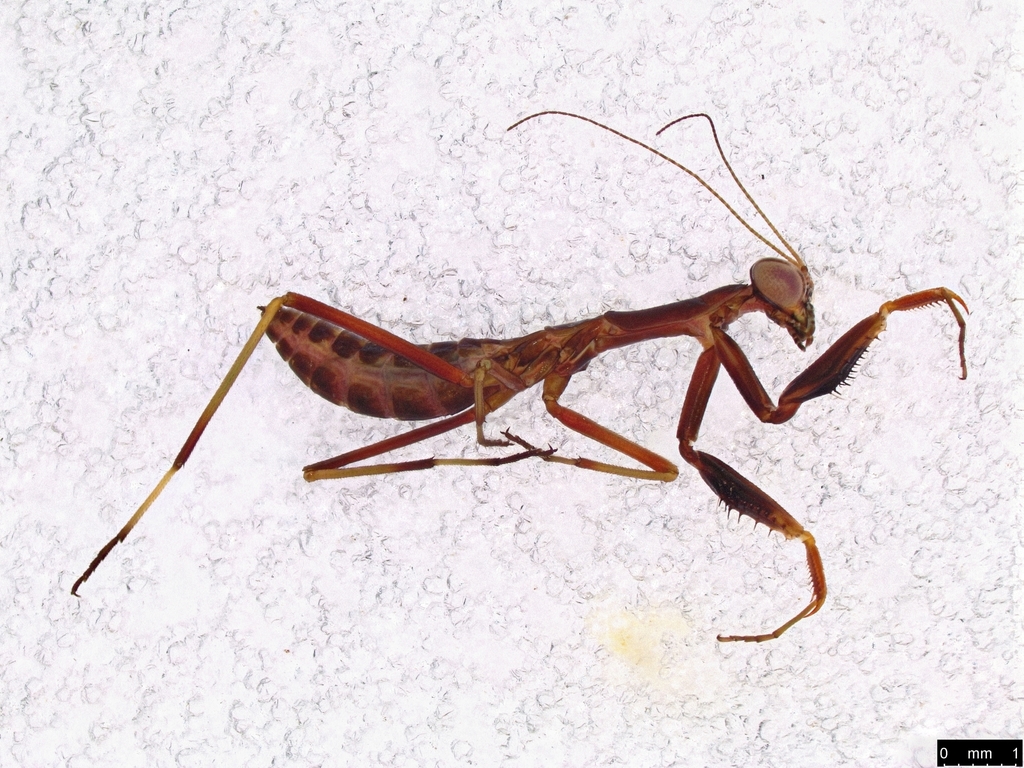
Females grow up to 70 mm and males to about 50 mm; females cannot fly while males have long wings. They are usually green or brown, sometimes showing a dark spot on each fore-leg femur, and can also appear in a purple-reddish-brown shade. They live in urban gardens, forests and woodlands across all Australian states, especially New South Wales and Queensland.
Source: Wikipedia
How to recognize it
Typical colours are green or brown, with occasional purple-reddish-brown individuals. Each raptorial foreleg has a distinctive dark spot on the femur.
Source: Wikipedia
Size
Females can reach about 70 mm in length, while males are smaller at around 50 mm.
Source: Wikipedia
What it eats
Starving females may practice sexual cannibalism, while well-fed females do not.
Source: Wikipedia
Life cycle
Females have very reduced wings and cannot fly; males have long wings and can fly. Starving females invest limited resources in releasing pheromones to attract males, even though they are less fecund.
Source: Wikipedia
Where it is found in the US
Recorded in 1 of 51 states and DC. Most records: California.
Darker = more records. Counts are museum and citizen-science records, not population size.
Source: GBIF
Questions people ask
What do they look like?
They are usually green or brown, sometimes purple-reddish-brown, and have a dark spot on each fore-leg femur.
Source: Wikipedia
Where might I find them in Australia?
They are most common in New South Wales and Queensland but occur in all Australian states, including Tasmania, in urban and forested habitats.
Source: Wikipedia
Same family (Mantidae)
Sources
- Wikipedia: https://en.wikipedia.org/wiki/False_garden_mantis
Look it up elsewhere: GBIF · iNaturalist · BugGuide · Wikipedia
Text written 2026-10-22 from the sources above and checked sentence by sentence against them. Data fetched 2026-10-22.