 Bug FAQ
Peppermint Stick Insect
Megacrania batesii · Order: Phasmida · Family: Phasmatidae
Source: Wikipedia
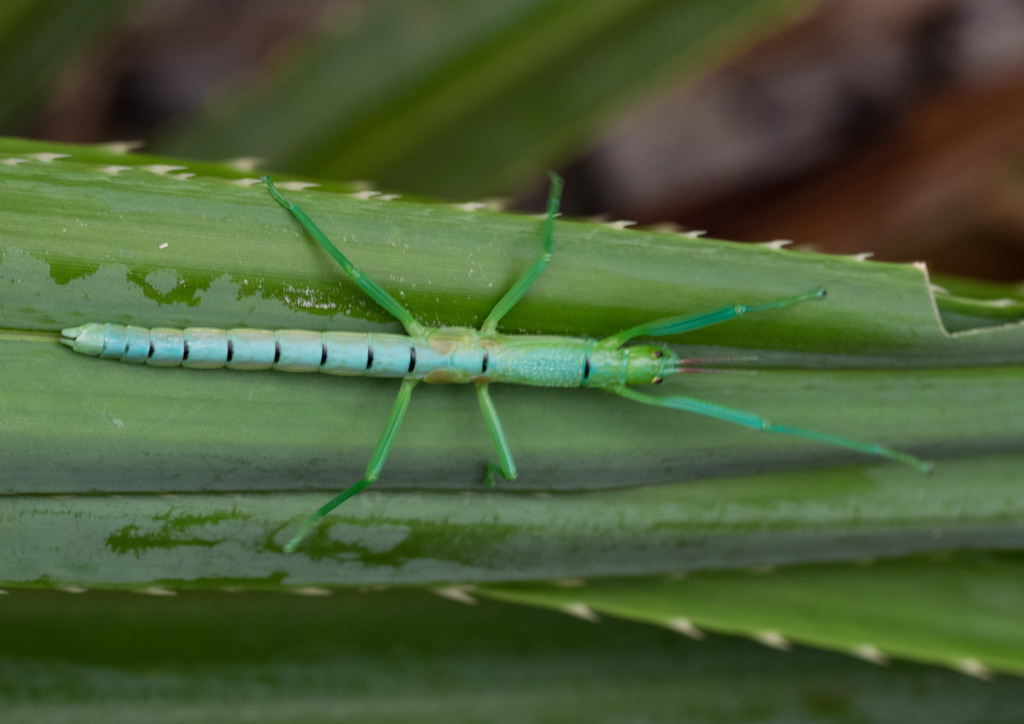
Adult peppermint stick insects are pale green and about 8 to 14 cm long, with females larger than males. When threatened they spray a peppermint-smelling fluid from glands on their prothorax. They live in lowland tropical rainforests near the beach, often on the upper surfaces of Pandanaceae leaves.
Source: Wikipedia
How to recognize it
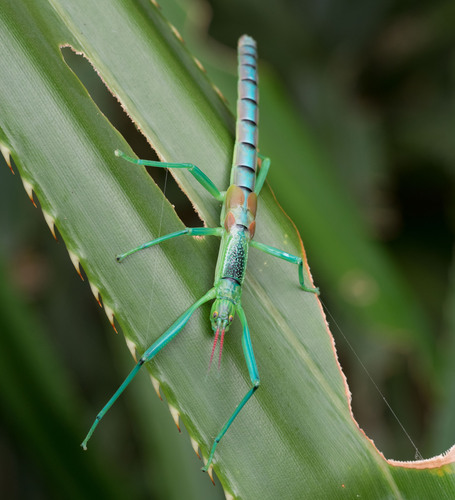
Their common name comes from the peppermint-scented defensive spray and their twig-like, cylindrical body. Adults and last-instar larvae are uniformly pale green, with the head, thorax and legs a slightly darker shade.
Source: Wikipedia
Size
Males measure 76 to 87 mm (3.0 to 3.4 in) in body length, while females are larger at 98 to 137 mm (3.9 to 5.4 in). Both sexes have similarly sized forewings, but males have relatively larger hind wings.
Source: Wikipedia
Is it a pest in the house?
Although they can heavily damage the pandanus plants they eat, these plants are not of major economic importance. An infestation in the Philippines has destroyed pandanus plants used for making mats.
Source: Wikipedia
Where it lives
They inhabit complex mesophyll vine forests at the forest-beach transition in lowland tropical and subtropical rainforests. Individuals are found in small numbers resting on the tops of Pandanaceae leaves.
Source: Wikipedia
What it eats
In captivity it will also eat other Pandanaceae such as Freycinetia spp., P. gemmifer, P. utilis, and P. whitei.
Source: Wikipedia
Life cycle
The species mainly reproduces by parthenogenesis, though sexual reproduction has been observed. Most wild specimens are female; males are uncommon.
Source: Wikipedia
More photos

Questions people ask
What does the peppermint stick insect spray?
It releases an irritating fluid with a peppermint-like odor from glands on its prothorax when threatened.
Source: Wikipedia
What plants does it eat?
In the wild it feeds on several Pandanaceae species, and in captivity it accepts other Pandanaceae like Freycinetia and various Pandanus.
Source: Wikipedia
Same family (Phasmatidae)
 Smooth Stick InsectClitarchus hookeri
 Margin-winged Stick InsectCtenomorpha marginipennisDamages trees, gardens or crops
 Prickly Stick InsectAcanthoxyla prasinaDamages trees, gardens or crops
 Spur Legged PhasmidDidymuria violescens
 Spiny Leaf insectExtatosoma tiaratumCan irritate skin
 Titan Stick InsectAcrophylla titan
Sources
- Wikipedia: https://en.wikipedia.org/wiki/Megacrania_batesii
Look it up elsewhere: GBIF · iNaturalist · BugGuide · Wikipedia
Text written 2026-10-23 from the sources above and checked sentence by sentence against them. Data fetched 2026-10-23.