 Bug FAQ
Pennsylvania Dingy Ground Beetle
Harpalus pensylvanicus · Order: Coleoptera · Family: Carabidae
Source: Wikipedia

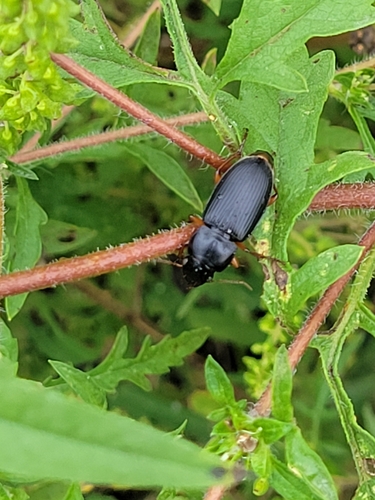
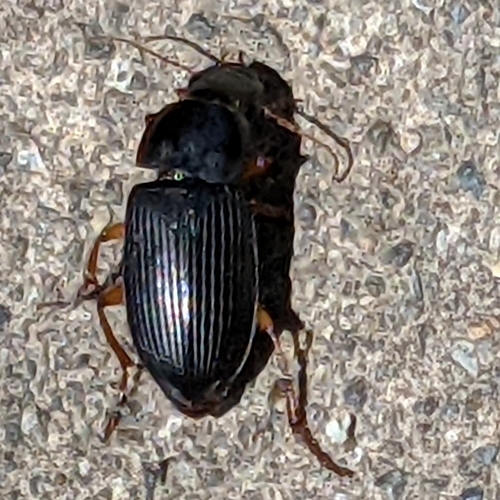
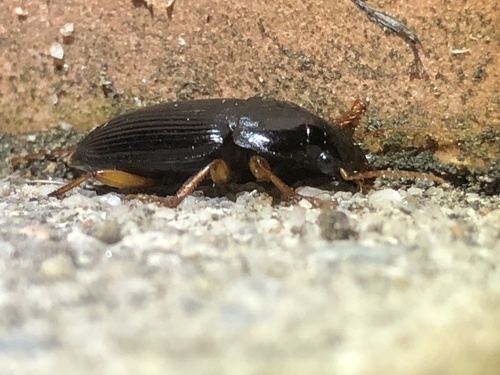
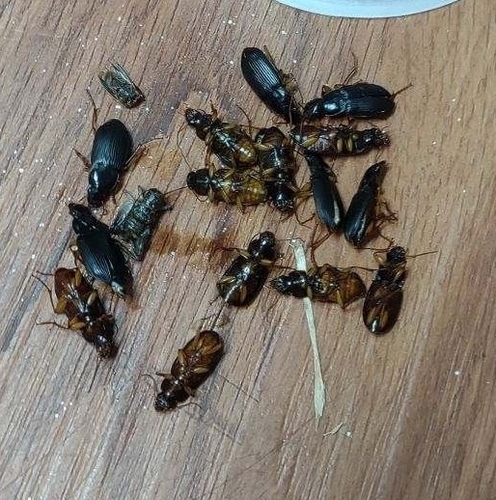
Adults are shiny black on top, reddish-brown underneath, with lined elytra, while larvae are black with a reddish head, tapered bodies and two long cerci. They prefer high hayfields over low maize fields, are attracted to lights, and are found throughout North America. They eat ragweed and grass seeds and act as important weed-seed predators, but may sometimes damage strawberries.
Source: Wikipedia
How to recognize it
Adults have a shiny black dorsal surface, a reddish-brown underside, and elytra with distinct lines. Larvae are black with a reddish head, a tapered body, and two long cerci.
Source: Wikipedia
Is it a pest in the house?
They sometimes damage ripening strawberries, likely to obtain water.
Source: Wikipedia
Where it lives
They favor high hayfields rather than low maize fields. They are drawn to artificial lights.
Source: Wikipedia
What it eats
They feed on ragweed seeds and various grass seeds. They serve as important predators of weed seeds.
Source: Wikipedia
Life cycle
Larvae are black with a reddish head, a tapered body, and two long cerci.
Source: Wikipedia
When you see it
They are attracted to lights during their active periods.
Source: Wikipedia
Where it comes from
The species occurs throughout North America.
Source: Wikipedia
Where it is found in the US
Recorded in 49 of 51 states and DC. Most records: Colorado, Kansas, Virginia, Mississippi, Pennsylvania, Arizona, Maryland, Alabama.
Darker = more records. Counts are museum and citizen-science records, not population size.
Source: GBIF
Status: native in North America; native in Canada; native in United States. Source: iNaturalist
Months it is reported in the US
Source: GBIF
More photos
Questions people ask
What do adult Pennsylvania Dingy Ground Beetles look like?
Adults are shiny black on top, reddish-brown underneath, with lined wing covers.
Source: Wikipedia
Where are these beetles commonly found?
They live throughout North America and prefer high hayfields over low maize fields.
Source: Wikipedia
Do they cause any damage to gardens or crops?
They can occasionally damage ripening strawberries.
Source: Wikipedia
What do they eat?
Their diet includes ragweed seeds and various grass seeds, and they help control weed seeds.
Source: Wikipedia
Same family (Carabidae)


Sources
- Wikipedia: https://en.wikipedia.org/wiki/Harpalus_pensylvanicus
Look it up elsewhere: GBIF · iNaturalist · BugGuide · ITIS · Wikipedia
Text written 2026-10-23 from the sources above and checked sentence by sentence against them. Data fetched 2026-10-23.