 Bug FAQ
Pebble Hook-tip
Drepana falcataria · Order: Lepidoptera · Family: Drepanidae
Source: Wikipedia
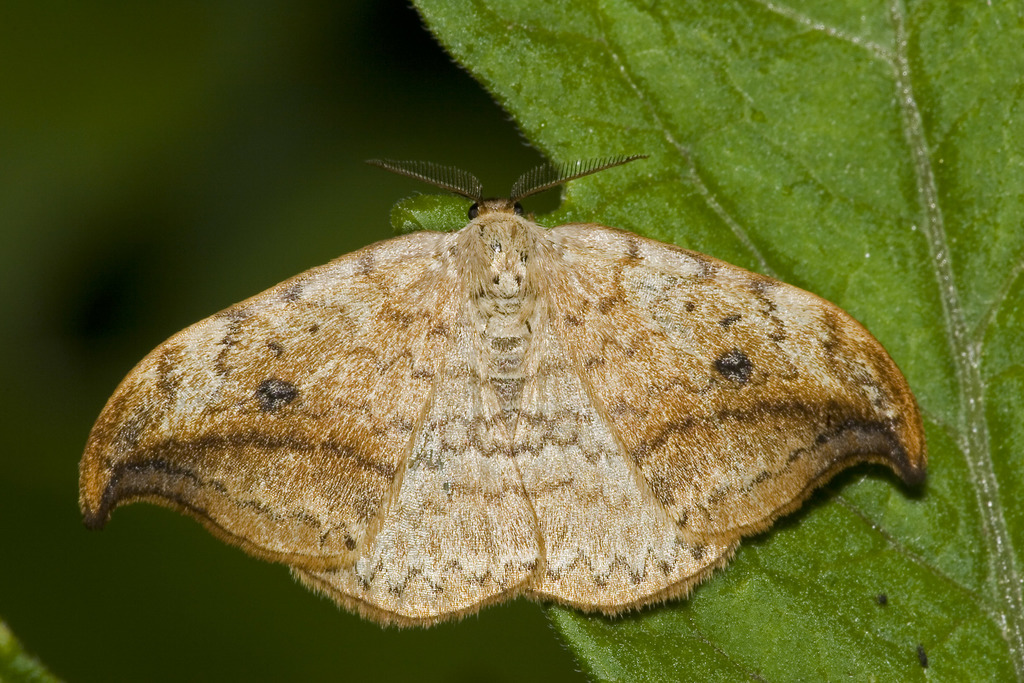
Pebble Hook-tip moths have a wingspan of about 27 to 35 mm and show light brown to reddish-brown forewings with a dark central patch and a purple stain near the outer edge, plus a curved dark brown band from the tip. They live in riparian forests, carr, moor edges, parks and gardens across Europe to Siberia and the eastern Palearctic, and they fly from April to August depending on location.
Source: Wikipedia
How to recognize it
The forewings are light brown to reddish-brown with fine dark serrated lines, a dark middle patch, a purple spot near the outer edge, and a clearly curved dark brown band that runs from the tip toward the edge. Hindwings are lighter brown than the forewings, and in females they appear white with the same dark patterning.
Source: Wikipedia
Size
The adult’s wingspan ranges from 27 to 35 mm.
Source: Wikipedia
What it eats
Caterpillars feed on birch leaves and occasionally on alder.
Source: Wikipedia
Life cycle
Eggs are yellow with an orange tip, and the final-instar caterpillar is green with a reddish-brown back and a black-marked yellowish head.
Source: Wikipedia
When you see it
Adults are on the wing from April through August, varying by location.
Source: Wikipedia
Where it comes from
Their range extends from Europe through Siberia to the eastern Palearctic.
Source: Wikipedia
Where it is found in the US
Recorded in 1 of 51 states and DC. Most records: Colorado.
Darker = more records. Counts are museum and citizen-science records, not population size.
Source: GBIF
More photos

Questions people ask
When can I see adult Pebble Hook-tip moths?
Adults fly from April to August, depending on where you are.
Source: Wikipedia
Where are these moths found?
They live in riparian forests, carr, moor edges, parks and gardens across Europe to Siberia and the eastern Palearctic.
Source: Wikipedia
Same family (Drepanidae)


Sources
- Wikipedia: https://en.wikipedia.org/wiki/Drepana_falcataria
Look it up elsewhere: GBIF · iNaturalist · BugGuide · Wikipedia
Text written 2026-10-22 from the sources above and checked sentence by sentence against them. Data fetched 2026-10-22.