 Bug FAQ
Oak Hook-tip
Watsonalla binaria · Order: Lepidoptera · Family: Drepanidae
Source: Wikipedia
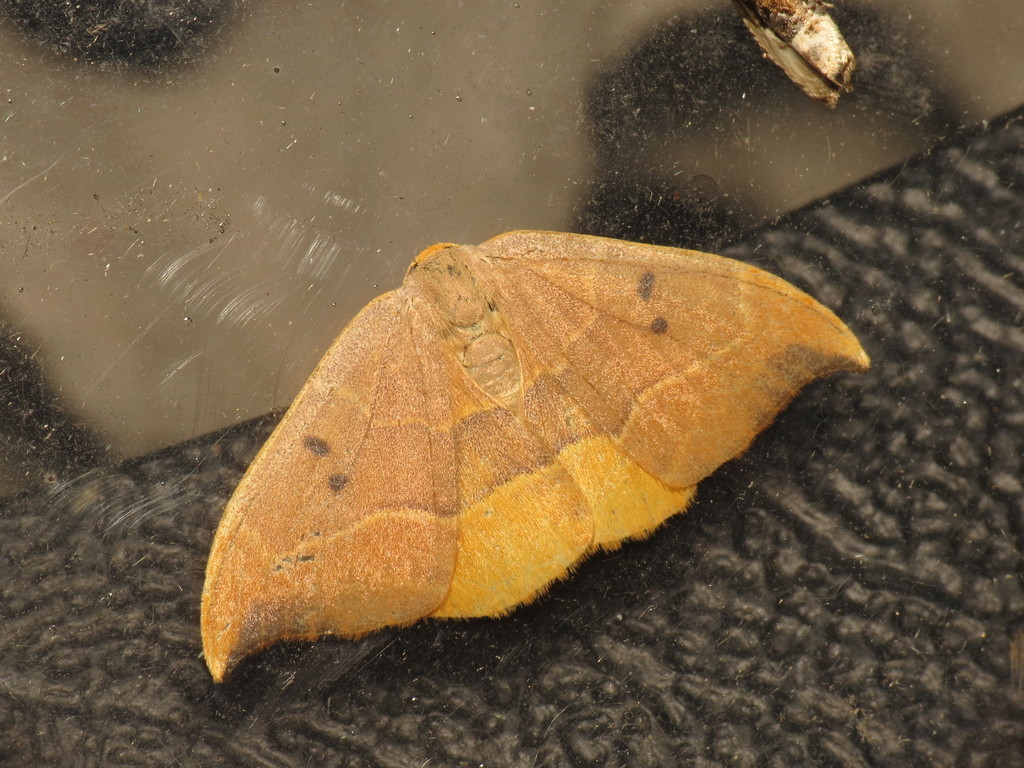
Oak Hook-tip moths have orange-brown forewings with three thin yellow bands and a hooked tip, plus two dark spots between the inner bands. Males have a wingspan of about 30 mm, females about 35 mm. They live across most of Europe (except the far north), fly at night but may be seen in daylight, and are attracted to light.
Source: Wikipedia
How to recognize it
The forewings are orange-brown with three narrow yellow bands; the outer band can be faint or missing, and two dark spots sit between the inner bands. The wing tip is hooked, which gives the species its common name.
Source: Wikipedia
Size
Males have a wingspan of roughly 30 mm, while females are larger at about 35 mm.
Source: Wikipedia
Where it lives
It occurs throughout most of Europe, but not in the far northern regions. Adults usually fly at night, are attracted to lights, and sometimes are seen during the day.
Source: Wikipedia
Life cycle
The species usually produces two generations each year, with adults on the wing in May-June and again in August. It overwinters in the pupal stage.
Source: Wikipedia
When you see it
Two broods appear each year, flying in late spring and again in late summer.
Source: Wikipedia
Where it comes from
Its range covers most of Europe, excluding the far north.
Source: Wikipedia
Lookalikes
Two black twin spots on the forewings are the clearest way to tell them apart.
Source: Wikipedia
More photos

Questions people ask
Are they a problem for my garden trees?
The caterpillars feed on oak and occasionally on alder, beech and birch, so they can cause some leaf damage to those trees.
Source: Wikipedia
Same family (Drepanidae)



Sources
- Wikipedia: https://en.wikipedia.org/wiki/Oak_hook-tip
Look it up elsewhere: GBIF · iNaturalist · BugGuide · Wikipedia
Text written 2026-10-22 from the sources above and checked sentence by sentence against them. Data fetched 2026-10-22.