 Bug FAQ
Pearl Crescent
Phyciodes tharos · Order: Lepidoptera · Family: Nymphalidae
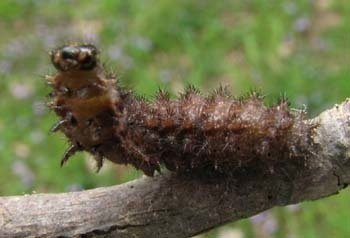
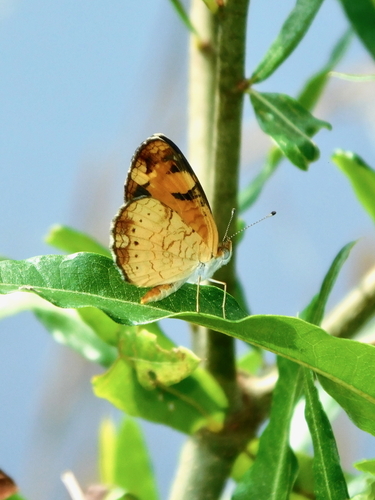
The pearl crescent butterfly has a wingspan of about 21 to 34 mm and shows orange upper wings with black borders and fine black markings across the post-median and sub-marginal areas. Adults sip nectar from many flowers, while the caterpillars feed on leaves and stay together when young; the species produces several broods from spring through fall in the north and year-round in the deep south and Mexico.
Source: Wikipedia
How to recognize it
Upper wings are orange with black borders and fine black marks in the postmedian and submarginal zones.
Source: Wikipedia
Size
Wingspan ranges from 21 to 34 mm.
Source: Wikipedia
Where it lives
Found in open areas like pastures, road edges, vacant lots, fields and open pine woods.
Source: Wikipedia
What it eats
Caterpillars eat leaves and stay in groups when young.
Source: Wikipedia
Life cycle
Produces several broods each year, from April to November in northern areas and year-round in the deep south and Mexico. Overwinters as a third-stage caterpillar.
Source: Wikipedia
When you see it
Multiple generations occur from spring through fall in the north and continuously in the deep south and Mexico.
Source: Wikipedia
Where it comes from
Native to North America, present throughout the United States except the west coast, throughout Mexico and parts of southern Canada, especially Ontario.
Source: Wikipedia
Lookalikes
Similar species include the tawny crescent (Phyciodes batesii) and the northern crescent (Phyciodes cocyta).
Source: Wikipedia
Where it is found in the US
Recorded in 50 of 51 states and DC. Most records: Texas, Illinois, Ohio, Virginia, Maryland, North Carolina, Pennsylvania, California.
Darker = more records. Counts are museum and citizen-science records, not population size.
Source: GBIF
Status: native in North America; native in Canada; native in United States. Source: iNaturalist
Months it is reported in the US
Source: GBIF
More photos
Questions people ask
How can I tell this butterfly apart from similar ones?
Look for orange upper wings with black borders and fine black marks, plus a dark marginal patch with a light crescent on the hindwing underside; other similar species are the tawny crescent and northern crescent.
Source: Wikipedia
Same family (Nymphalidae)






Sources
- Wikipedia: https://en.wikipedia.org/wiki/Pearl_crescent
Look it up elsewhere: GBIF · iNaturalist · BugGuide · ITIS · Wikipedia
Text written 2026-10-22 from the sources above and checked sentence by sentence against them. Data fetched 2026-10-22.