 Bug FAQ
Peacock Pansy
Junonia almana · Order: Lepidoptera · Family: Nymphalidae
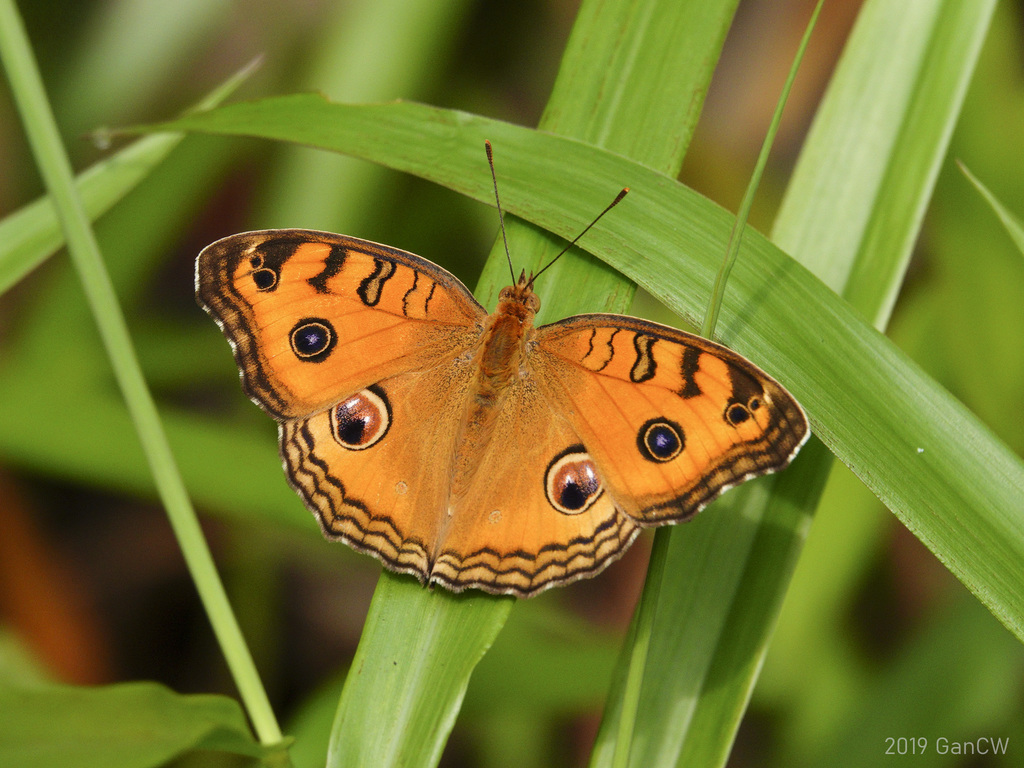
Its upperside is bright orange-yellow with distinctive black bars and several eye-like spots; the underside is brown with variable sinuous lines and spots. It lives across India, Sri Lanka, South-East Asia, China and Japan, and its caterpillars feed on plants such as Hygrophila auriculata, Phyla nodiflora, Acanthus, Barleria and Gloxinia.
Source: Wikipedia
How to recognize it
The butterfly’s upper wings are rich orange-yellow with dark transverse bars, black marginal lines, and several white-centered ocelli; the lower wings are ochraceous brown with variable dark sinuous bands and pale lines.
Source: Wikipedia
Size
Adults have a wingspan ranging from 54 to 62 mm (about 2.1 to 2.4 inches).
Source: Wikipedia
Where it lives
Peacock Pansies are found in India, Sri Lanka, South-East Asia, and extend eastward to China and Japan.
Source: Wikipedia
Life cycle
There are two adult forms: a dry-season form with few underside markings and a wet-season form with extra eyespots and lines.
Source: Wikipedia
Where it comes from
The species occurs in Cambodia and South Asia.
Source: Wikipedia
Where it is found in the US
Recorded in 1 of 51 states and DC. Most records: New York.
Darker = more records. Counts are museum and citizen-science records, not population size.
Source: GBIF
More photos
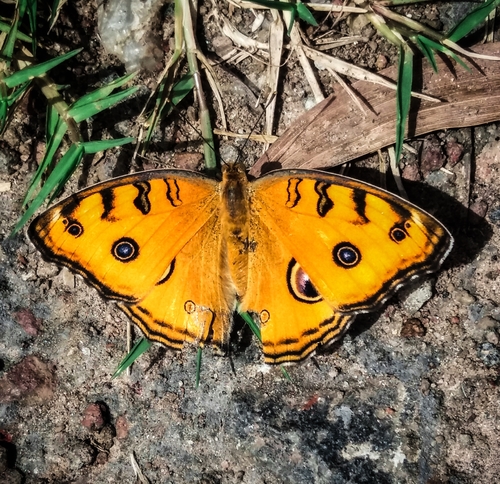
Same family (Nymphalidae)






Sources
- Wikipedia: https://en.wikipedia.org/wiki/Junonia_almana
Look it up elsewhere: GBIF · iNaturalist · BugGuide · Wikipedia
Text written 2026-10-22 from the sources above and checked sentence by sentence against them. Data fetched 2026-10-22.