 Bug FAQ
Paulista Bumble Bee
Bombus pauloensis · Order: Hymenoptera · Family: Apidae
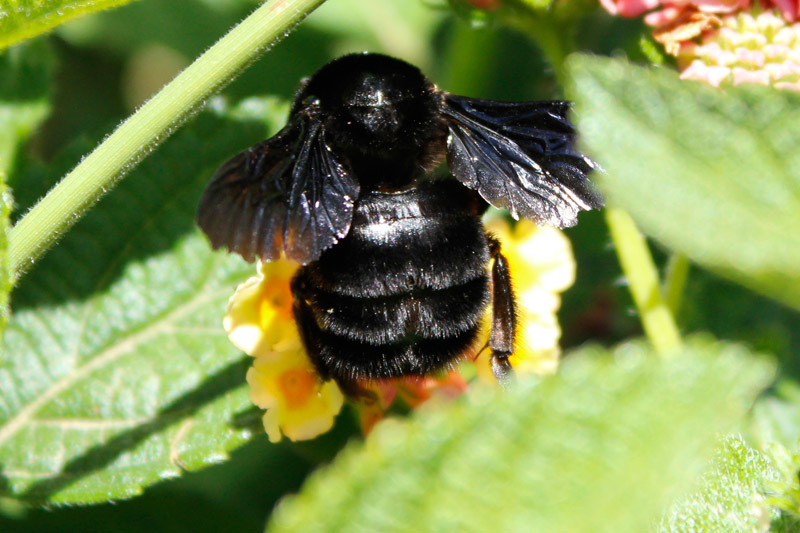
Workers have wing lengths of 4 to 10 mm and queens weigh two to three times as much as workers. They are mainly black, with a completely black thorax and a black abdomen that shows a small patch of lighter hair near the tip. Nests are built above ground in many settings, from warm tropical areas to cold high-altitude sites across South America, and colonies can start at any time of year.
Source: Wikipedia
How to recognize it
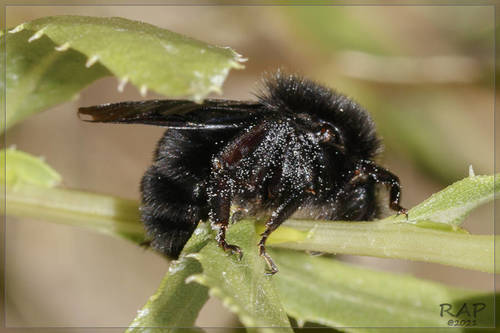
Bombus pauloensis is mostly black, with a fully black thorax and a black abdomen that has a small amount of lighter hair toward the end.
Source: Wikipedia
Size
Worker wing length ranges from 4 to 10 mm, and queens are typically two to three times heavier than workers.
Source: Wikipedia
Where it lives
Their nests are usually located above ground and have been found in a wide variety of places, from warm tropical zones to cold high-altitude environments.
Source: Wikipedia
What it eats
Foraging workers collect nectar and pollen, storing pollen in larval pockets and nectar in pots.
Source: Wikipedia
Life cycle
A colony starts when a solitary gyne builds an egg cell in a shallow underground cavity; eggs develop in about 6 days and larvae take 12 to 13 days to mature.
Source: Wikipedia
When you see it
New colonies can be founded at any time of year, although the shift to reproductive drones and gynes is not fully understood.
Source: Wikipedia
Where it comes from
They occur throughout many geographic areas and climates across South America.
Source: Wikipedia
Lookalikes
Within Bombus, B. pauloensis belongs to the former New World subgenus Fervidobombus, which also includes B. transversalis and B. pullatus, and is now placed in the larger subgenus Thoracobombus.
Source: Wikipedia
Where it is found in the US
Recorded in 2 of 51 states and DC. Most records: Texas, Georgia.
Darker = more records. Counts are museum and citizen-science records, not population size.
Source: GBIF
More photos
Questions people ask
How can I recognize a Paulista Bumble Bee?
They are mostly black, with a completely black thorax and a black abdomen that has a small patch of lighter hair near the tip.
Source: Wikipedia
Where does this bumble bee build its nest?
Nests are usually built above ground and have been found in many locations, from warm tropical areas to cold high-altitude sites.
Source: Wikipedia
What other bumble bees look similar?
It is closely related to Bombus transversalis and Bombus pullatus, all formerly placed in the subgenus Fervidobombus, now part of Thoracobombus.
Source: Wikipedia
Same family (Apidae)


Sources
- Wikipedia: https://en.wikipedia.org/wiki/Bombus_pauloensis
Look it up elsewhere: GBIF · iNaturalist · BugGuide · ITIS · Wikipedia
Text written 2026-10-23 from the sources above and checked sentence by sentence against them. Data fetched 2026-10-22.