 Bug FAQ
Paris Peacock Swallowtail
Papilio paris · Order: Lepidoptera · Family: Papilionidae
Also called: Paris Peacock
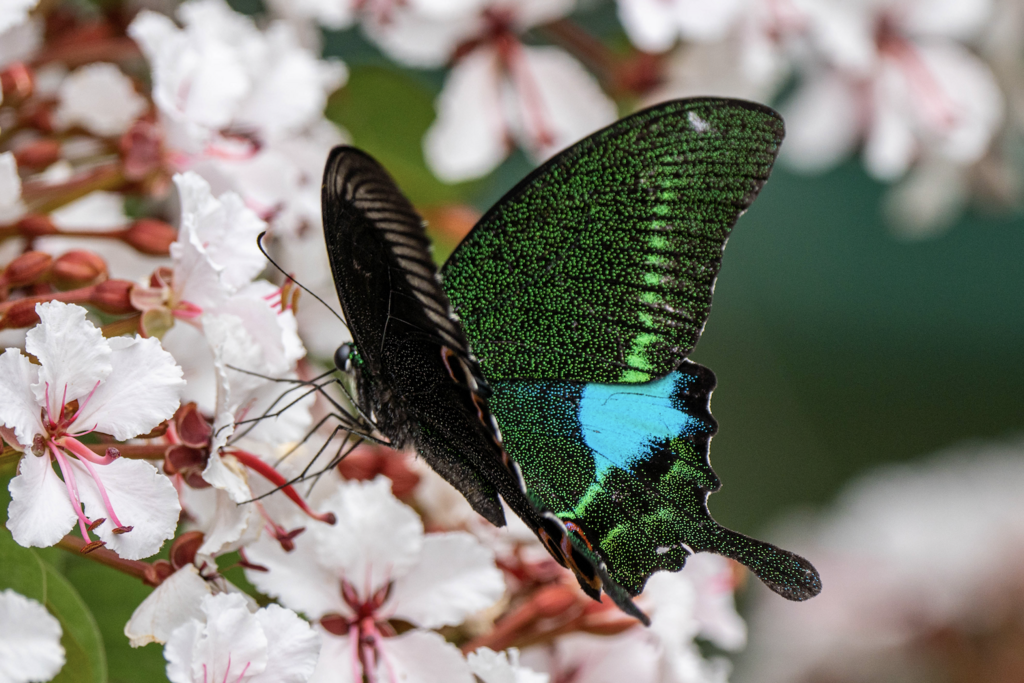
The Paris Peacock Swallowtail has a wingspan of about 106 to 132 mm and displays black wings sprinkled with dark-green scales, a bright blue patch on the hindwing, and distinctive red-black eyespots (size, id_marks, ). It lives in the Himalayas from Kumaon to Sikkim, Nepal, Bhutan, Assam, Burma, Tenasserim, Thailand and the Malay Peninsula, and is common up to 5,000 ft in Sikkim (habitat, ).
Source: Wikipedia
How to recognize it
Upper wings are black with dark-green speckles that form an incomplete narrow band on the forewing. Hindwing has green speckles that stop at the costal margin, a bright blue patch near the centre, and a prominent claret-red eyespot with a violet-blue line at the tornal angle.
Source: Wikipedia
Size
Wingspan ranges from 106 to 132 mm.
Source: Wikipedia
Where it lives
Found in the Himalayas from Kumaon to Sikkim, Nepal, Bhutan, the hills of Assam, Burma, Tenasserim, Thailand and the Malay Peninsula. Common in Sikkim from the Terai up to about 5,000 ft (1,500 m).
Source: Wikipedia
Where it comes from
Native to the Indian subcontinent and Southeast Asia. Occurs throughout the Himalayas, Assam, Burma, Tenasserim, Thailand and the Malay Peninsula.
Source: Wikipedia
Lookalikes
Similar to Papilio polyctor in the shape of the subterminal band on the forewing.
Source: Wikipedia
Same family (Papilionidae)

Sources
- Wikipedia: https://en.wikipedia.org/wiki/Papilio_paris
Look it up elsewhere: GBIF · iNaturalist · BugGuide · Wikipedia
Text written 2026-10-22 from the sources above and checked sentence by sentence against them. Data fetched 2026-10-22.