 Bug FAQ
Oriental Rat Flea
Xenopsylla cheopis · Order: Siphonaptera · Family: Pulicidae
Also called: Plague Flea, Rat Flea
Source: Wikipedia

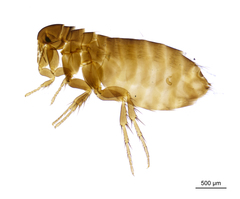
The Oriental rat flea is about 2.5 mm long and lacks the combs seen on many other fleas. Females lay up to 50 eggs each day and the insect goes through four life stages. It feeds on a variety of hosts, including humans, and can spread disease when it bites.
Source: Wikipedia
How to recognize it
It has no genal or pronotal combs and its body is divided into head, thorax, and abdomen.
Source: Wikipedia
Size
The flea’s body measures about one-tenth of an inch (≈2.5 mm).
Source: Wikipedia
Does it bite or sting?
When it bites, it can mechanically transmit disease-causing pathogens.
Source: Wikipedia
What it eats
Young fleas eat dead skin cells, flea droppings and tiny parasites in dust. Adult fleas can suck blood from their hosts.
Source: Wikipedia
Life cycle
A flea’s life includes four distinct stages. A single female can mate once and lay up to 50 eggs each day.
Source: Wikipedia
Where it comes from
It was first collected in Shendi, Sudan and described in 1903.
Source: Wikipedia
Lookalikes
These traits help tell it apart from cat fleas, dog fleas and other species.
Source: Wikipedia
Where it is found in the US
Recorded in 31 of 51 states and DC. Most records: Georgia, California, Arkansas, New Hampshire, Hawaii, Florida, Texas, Illinois.
Darker = more records. Counts are museum and citizen-science records, not population size.
Source: GBIF
Status: introduced in Canada. Source: iNaturalist
Months it is reported in the US
Source: GBIF
More photos


Questions people ask
Do Oriental rat fleas bite people?
Yes, they will bite humans as well as other animals.
Source: Wikipedia
Can they spread disease?
Their bites can mechanically transmit pathogens that cause disease.
Source: Wikipedia
What do the larvae eat?
Larvae feed on dead skin cells, flea droppings and other tiny particles in dust.
Source: Wikipedia
Same family (Pulicidae)




Sources
- Wikipedia: https://en.wikipedia.org/wiki/Oriental_rat_flea
Look it up elsewhere: GBIF · iNaturalist · BugGuide · ITIS · Wikipedia
Text written 2026-10-22 from the sources above and checked sentence by sentence against them. Data fetched 2026-10-22.