 Bug FAQ
Oriental Mole Cricket
Gryllotalpa orientalis · Order: Orthoptera · Family: Gryllotalpidae
Source: Wikipedia
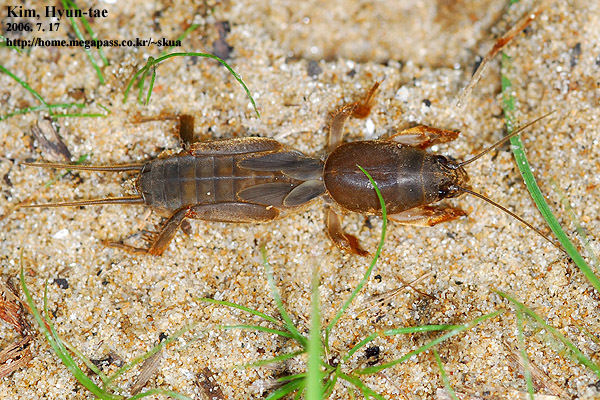
The Oriental mole cricket is a plump, yellow-brown insect about 20 mm long, with a paler underside and distinct colour changes as it grows. It lives in damp, rich soils underground, emerging at night when temperatures rise above about 12 °C, and it feeds on plant roots as well as other invertebrates, causing serious damage to many crops. Control methods include deep ploughing, traps, soil fumigation, poison baits, insecticides, and the introduction of parasitoid wasps of the genus Larra.
Source: Wikipedia
How to recognize it
Newly hatched nymphs have a blue-white prothorax and legs; later stages turn gray-black with white markings and develop short wing pads before becoming adults.
Source: Wikipedia
Size
Adults are about 20 mm long, plump, yellowish-brown on top and paler underneath.
Source: Wikipedia
Is it a pest in the house?
In Hawaii it damages sugarcane and irrigation ditch banks; in Asia it gnaws roots of wheat, rice, maize, beans, potatoes and many other crops.
Source: Wikipedia
How to get rid of it
The parasitoid wasp Larra polita was successfully introduced to Hawaii in 1925 and helps suppress mole cricket populations.
Source: Wikipedia
Where it lives
It lives underground in damp soil, creating a network of tunnels in flood plains, stream banks, arable land and gardens.
Source: Wikipedia
What it eats
It feeds on plant roots, tubers and rhizomes and also preys on insects, earthworms and other invertebrates.
Source: Wikipedia
Life cycle
Females lay about 200 eggs in a deep nesting chamber; eggs hatch in ten days and the whole life cycle lasts 1 to 3 years, with adults overwintering about a meter underground.
Source: Wikipedia
When you see it
Adults emerge at night in the evenings, are attracted to lights, and may appear in mass when temperatures reach 12 to 15 °C.
Source: Wikipedia
Lookalikes
It was once confused with G. africana, but was recognized as a separate species in the 1980s.
Source: Wikipedia
Where it is found in the US
Recorded in 1 of 51 states and DC. Most records: Hawaii.
Darker = more records. Counts are museum and citizen-science records, not population size.
Source: GBIF
Status: introduced in United States. Source: iNaturalist
Questions people ask
How can I get rid of Oriental mole crickets?
Use deep ploughing, traps, soil fumigation, poison baits or insecticides, and consider introducing Larra wasps where permitted.
Source: Wikipedia
What damage do they cause to my garden?
They chew the roots, tubers and rhizomes of many garden plants and crops, leading to wilting and reduced yields.
Source: Wikipedia
When are they most likely to appear?
Adults emerge at night when temperatures rise above about 12 °C and are attracted to lights.
Source: Wikipedia
Same family (Gryllotalpidae)


Sources
- Wikipedia: https://en.wikipedia.org/wiki/Gryllotalpa_orientalis
Look it up elsewhere: GBIF · iNaturalist · BugGuide · Wikipedia
Text written 2026-10-23 from the sources above and checked sentence by sentence against them. Data fetched 2026-10-22.