 Bug FAQ
European Mole Cricket
Gryllotalpa gryllotalpa · Order: Orthoptera · Family: Gryllotalpidae
Also called: Mole Cricket
Source: Wikipedia
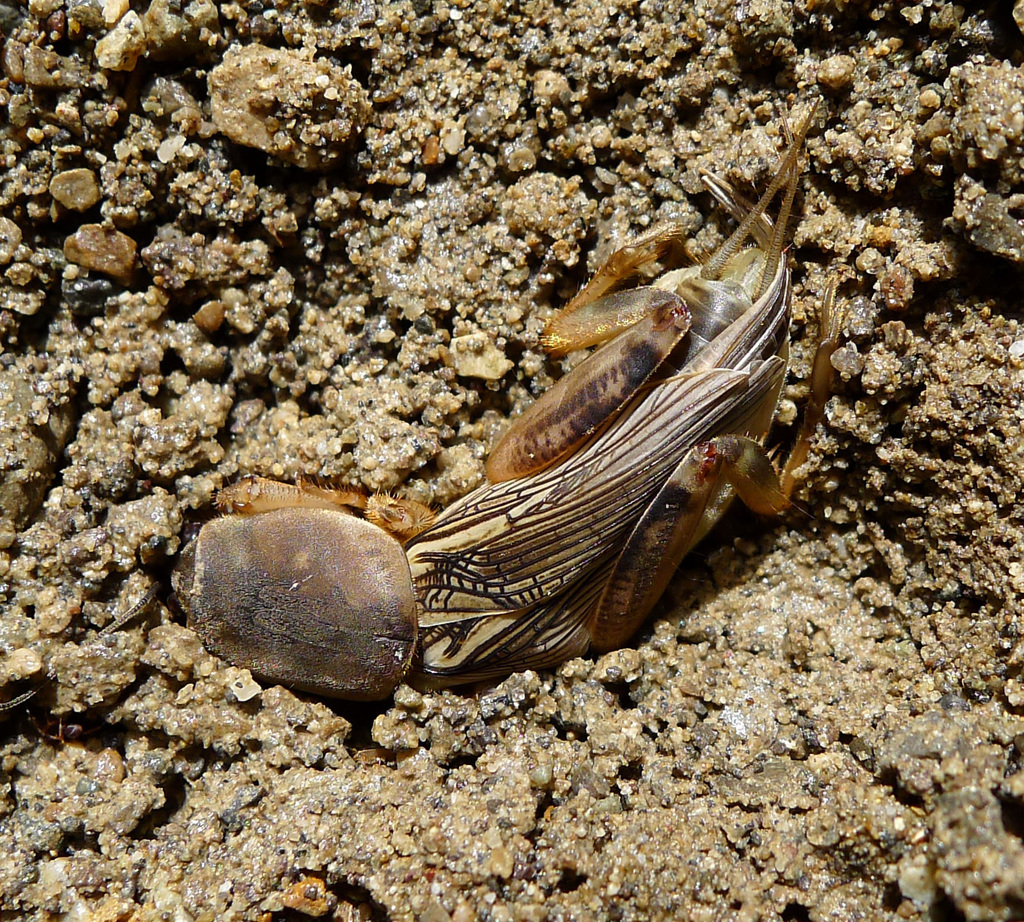
The European mole cricket is a dark brown insect with a silky sheen, fine velvety hairs and a yellowish underside. Males are about 50 mm long and have an open-vein area on the forewing, while females are larger (≈70 mm) and lack an external ovipositor. It lives in damp, rich soils and can cause serious damage to a wide range of crops and garden plants.
Source: Wikipedia
How to recognize it
It is dark brown with a silky shimmer, a yellowish underside and fine velvety hairs. Males have an open-vein area called the ‘harp’ on the forewing; females lack the external ovipositor seen in other crickets.
Source: Wikipedia
Size
Males are about 50 mm (2 in) long, females about 70 mm (2.8 in).
Source: Wikipedia
Is it a pest in the house?
In areas where it is abundant, it is a pest of cereals, legumes, potatoes, vegetables, beet, sunflower, tobacco, hemp, flax, strawberry and other crops. It also damages seedlings in nurseries and the roots of vines, fruit trees and other trees.
Source: Wikipedia
How to get rid of it
Control methods include deep autumn plowing, soil treatments between crop rows, winter trapping, pesticides, poison baits and soil fumigation.
Source: Wikipedia
Where it lives
It prefers damp, nutrient-rich soils such as flood plains, reservoir edges, irrigated fields and vegetable gardens.
Source: Wikipedia
What it eats
It is omnivorous, feeding on plant roots, tubers, rhizomes and various soil invertebrates.
Source: Wikipedia
Life cycle
Females lay 100 to 350 eggs in an underground chamber each spring. Nymphs molt six times and may take one to three years to become adults.
Source: Wikipedia
When you see it
Males produce their characteristic sounds on warm, mild evenings in early spring.
Source: Wikipedia
Lookalikes
Several similar species exist in the Gryllotalpidae family, and cryptic species are distinguished mainly by their song patterns.
Source: Wikipedia
Where it is found in the US
Recorded in 7 of 51 states and DC. Most records: New York, Connecticut, Florida, Ohio, Oklahoma, Pennsylvania, New Jersey.
Darker = more records. Counts are museum and citizen-science records, not population size.
Source: GBIF
Status: introduced in United States. Source: iNaturalist
Months it is reported in the US
Source: GBIF
Questions people ask
How can I get rid of European mole crickets?
Use deep autumn plowing, treat the soil between rows, set winter traps, apply pesticides or poison baits, and consider soil fumigation.
Source: Wikipedia
What do European mole crickets look like?
They are dark brown with a silky sheen, a yellowish underside, fine velvety hairs, and males have an open-vein ‘harp’ on the forewing.
Source: Wikipedia
When are mole crickets most active?
Males usually chirp on warm, mild evenings in early spring.
Source: Wikipedia
Same family (Gryllotalpidae)


Sources
- Wikipedia: https://en.wikipedia.org/wiki/Gryllotalpa_gryllotalpa
Look it up elsewhere: GBIF · iNaturalist · BugGuide · ITIS · Wikipedia
Text written 2026-10-22 from the sources above and checked sentence by sentence against them. Data fetched 2026-10-22.