 Bug FAQ
Oriental Fruit Fly
Bactrocera dorsalis · Order: Diptera · Family: Tephritidae
Source: cms.ctahr.hawaii.edu

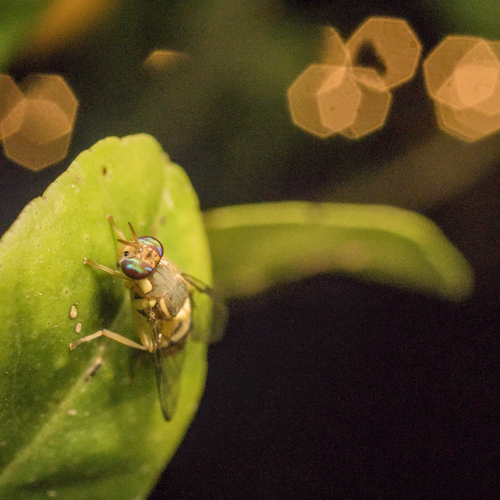
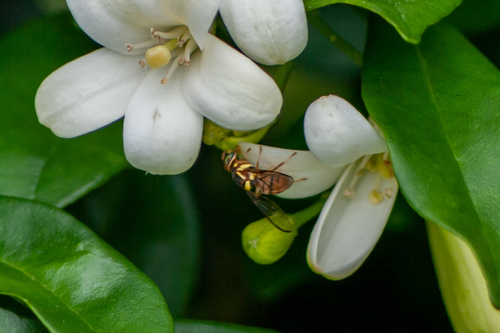
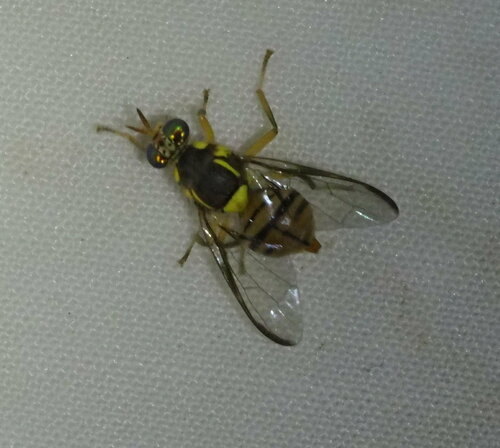
The oriental fruit fly is about 8 mm long with 7.3 mm wings and has distinctive yellow thorax markings and a dark T-shaped band on the abdomen. It attacks over 300 fruit species, laying eggs in ripe fruit and causing damage through larval feeding and secondary microbial decay.
Source: Wikipedia, cms.ctahr.hawaii.edu
How to recognize it
Two vertical yellow spots on the thorax and a dark T-shaped band across the abdomen set it apart from related flies.
Source: Wikipedia
Size
Adults are roughly 8 mm long, with wings about 7.3 mm in length.
Source: Wikipedia
Is it a pest in the house?
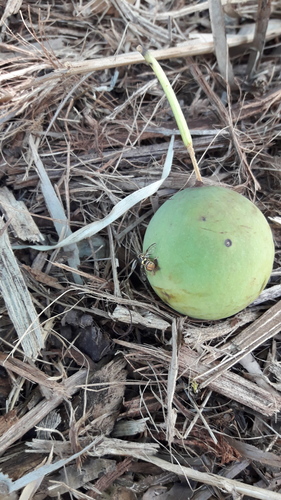
The fly has been recorded in California and Florida. It attacks over 300 fruit types, including mango, papaya, citrus, avocado, banana, and tomato. Damage results from egg laying, larval feeding, and decay caused by secondary microbes.
Source: Wikipedia, cms.ctahr.hawaii.edu
How to get rid of it
Wrapping fruit in paper or polyethylene sleeves is an effective control method. Parasitoid wasps such as Fopius arisanus are used in Hawaii to suppress populations. Integrated pest management combines chemical and non-chemical tactics. Eradication programs may enforce quarantines, set traps, and remove infested fruit from properties. Pre-harvest practices help lower fly numbers before harvest. Toxicants are used in bait formulations and sprays are applied for control.
Source: Wikipedia, USDA APHIS, cms.ctahr.hawaii.edu
Where it lives
It lives in tropical and subtropical regions and is found across Southeast Asia, the USA, China, the UAE, India, and many other countries.
Source: Wikipedia
What it eats
It feeds on a wide range of cultivated and wild fruits, making it a major pest of many crops. Adults also visit certain orchids that release methyl eugenol, which attracts them.
Source: Wikipedia
Life cycle
It is closely related to B. carambolae and B. occipitalis and shares several synonyms such as B. papayae and B. invadens.
Source: Wikipedia
When you see it
Males are strongly attracted to methyl eugenol, a chemical used in monitoring and control programs.
Source: Wikipedia
Where it comes from
The species originates from Southeast Asia.
Source: Wikipedia
Lookalikes
It resembles the related species B. carambolae and B. occipitalis. Its scientific name has been used for several synonyms, including B. papayae, B. invadens, and B. philippinensis.
Source: Wikipedia
Where it is found in the US
Recorded in 3 of 51 states and DC. Most records: Hawaii, Kansas, California.
Darker = more records. Counts are museum and citizen-science records, not population size.
Source: GBIF
Months it is reported in the US
Source: GBIF
More photos
Questions people ask
How can I identify an oriental fruit fly?
Look for a small (≈8 mm) fly with two yellow spots on the thorax and a dark T-shaped band on the abdomen.
Source: Wikipedia
What crops does this fly damage?
It attacks more than 300 fruit species, including mango, papaya, citrus, avocado, banana, and tomato.
Source: cms.ctahr.hawaii.edu
How can I control an infestation?
Use fruit-wrapping sleeves, bait traps with methyl eugenol, parasitoid wasps, and follow integrated pest-management guidelines such as quarantines and pre-harvest practices.
Source: Wikipedia, USDA APHIS, cms.ctahr.hawaii.edu
Same family (Tephritidae)


Sources
- cms.ctahr.hawaii.edu: https://cms.ctahr.hawaii.edu/ckm/Home/Insects-and-Other-Pests/Flies/Bactrocera-dorsalis
- Wikipedia: https://en.wikipedia.org/wiki/Bactrocera_dorsalis
- USDA APHIS: https://www.aphis.usda.gov/plant-pests-diseases/fruit-flies
Look it up elsewhere: GBIF · iNaturalist · BugGuide · ITIS · Wikipedia
Text written 2026-10-23 from the sources above and checked sentence by sentence against them. Data fetched 2026-10-23.