 Bug FAQ
Northern Sandy Dung Beetle
Euoniticellus intermedius · Order: Coleoptera · Family: Scarabaeidae
Also called: Intermediate sandy dung beetle
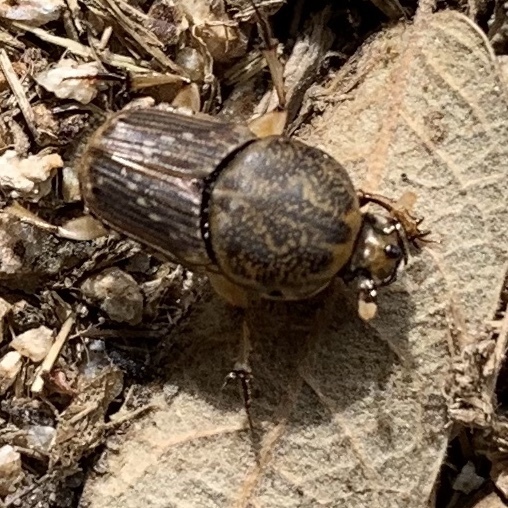
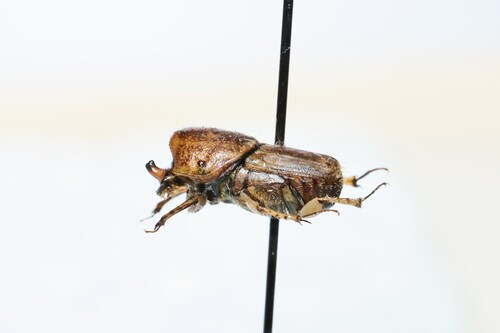
Adult Northern Sandy Dung Beetles are 6 to 10 mm long and brown, with males showing blunt, curved horns used in fights for mates. They feed on dung, adults taking the nutrient-rich particles while larvae consume the coarser, fibrous parts.
Source: Wikipedia
How to recognize it
Both sexes are brown, but males have blunt, curved horns used in male-to-male fights for females.
Source: Wikipedia
Size
Adults measure between 6 mm and 10 mm in length.
Source: Wikipedia
Where it lives
They are most common in livestock pastures and other areas with abundant dung. The species tolerates hot, dry conditions well.
Source: Wikipedia
What it eats
Adults feed on the nutrient-rich particulate portion of dung, while larvae eat the coarser, fibrous parts.
Source: Wikipedia
Life cycle
They undergo complete metamorphosis: egg, larva, pupa, then adult. Development from egg to adult takes about six weeks, and adults live roughly two months.
Source: Wikipedia
When you see it
They can survive a wider temperature range than many other dung beetles. They are resistant to agrochemicals and stay active in the afternoon when most dung beetles are dormant.
Source: Wikipedia
Where it comes from
Originally from the Afrotropical region, ranging from Ethiopia to South Africa.
Source: Wikipedia
Where it is found in the US
Recorded in 7 of 51 states and DC. Most records: Texas, Arizona, New Mexico, California, Florida, Hawaii, Mississippi.
Darker = more records. Counts are museum and citizen-science records, not population size.
Source: GBIF
Months it is reported in the US
Source: GBIF
More photos
Questions people ask
What do they look like?
They are brown; males have blunt, curved horns used in fights for mates.
Source: Wikipedia
What do they eat?
Adults eat the nutrient-rich particles of dung, while larvae consume the coarser, fibrous portions.
Source: Wikipedia
Same family (Scarabaeidae)
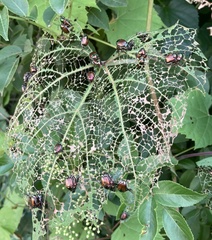 Japanese BeetlePopillia japonicaDamages trees, gardens or crops
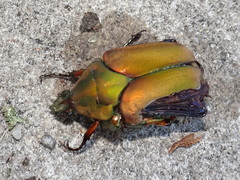 Common Green June BeetleCotinis nitidaDamages trees, gardens or crops
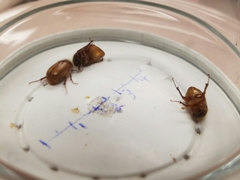 Phyllophaga crinitaDamages trees, gardens or crops
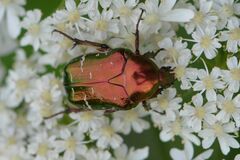 European Rose ChaferCetonia aurata
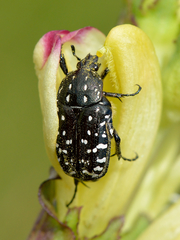 Mediterranean Spotted ChaferOxythyrea funestaDamages trees, gardens or crops
 Oriental BeetleExomala orientalisDamages trees, gardens or crops
Sources
- Wikipedia: https://en.wikipedia.org/wiki/Euoniticellus_intermedius
Look it up elsewhere: GBIF · iNaturalist · BugGuide · ITIS · Wikipedia
Text written 2026-10-27 from the sources above and checked sentence by sentence against them. Data fetched 2026-10-27.