 Bug FAQ
Northern Blue
Lycaeides idas · Order: Lepidoptera · Family: Lycaenidae
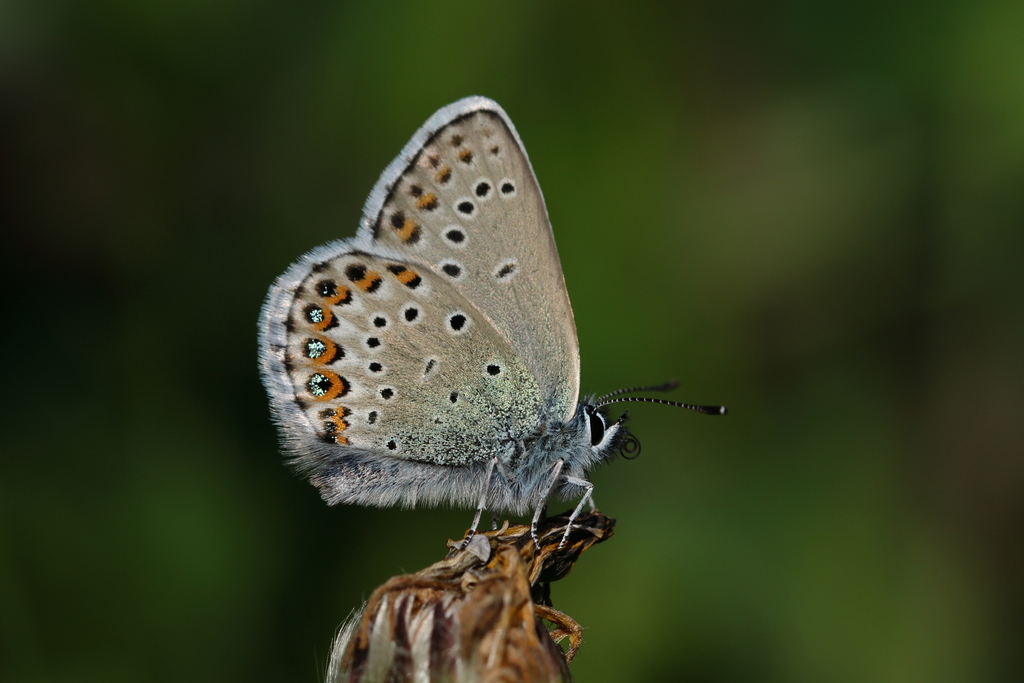
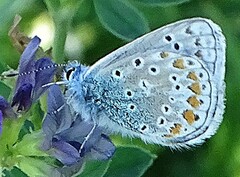
The Northern Blue has a wingspan of about 17 to 28 mm and males show an iridescent blue upper wing surface, while females are brown with orange spots near the edge.
Source: Wikipedia
How to recognize it
Males have a shiny blue upper side of the wings; females are brown with orange sub-marginal spots.
Source: Wikipedia
Size
Wingspan ranges from 17 to 28 mm.
Source: Wikipedia
Life cycle
Second-stage caterpillars overwinter before completing development.
Source: Wikipedia
When you see it
The flight period is June through August, varying with region.
Source: Wikipedia
Where it comes from
It occurs in North America as part of the Nearctic realm. It is also native to most of Europe (excluding parts of Spain, southern Italy and the UK) and the northern Palearctic, including Siberia and Yakutia.
Source: Wikipedia
Lookalikes
It closely resembles the Silver-studded Blue (Plebejus argus) and Reverdin’s Blue (Plebejus argyrognomon). A distinguishing feature is that male Northern Blues lack the hook on the foreleg that is present in Plebejus argus.
Source: Wikipedia
Where it is found in the US
Recorded in 16 of 51 states and DC. Most records: Alaska, Idaho, Montana, Washington, Wyoming, Oregon, California, Minnesota.
Darker = more records. Counts are museum and citizen-science records, not population size.
Source: GBIF
Status: native in North America; native in Canada; native in United States. Source: iNaturalist
Months it is reported in the US
Source: GBIF
More photos

Questions people ask
How can I identify the Northern Blue?
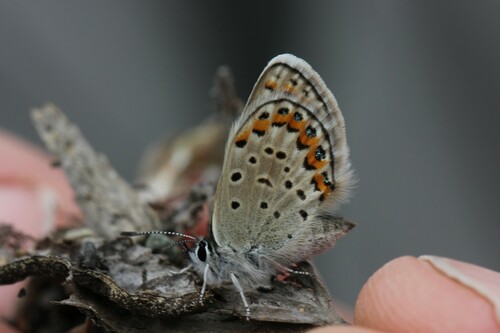
Males show an iridescent blue upper wing surface, females are brown with orange spots, and both have a greyish underside with black spots and a thin black line along the edge.
Source: Wikipedia
When are Northern Blues active?
Adults are on the wing in a single generation from June to August, depending on where they live.
Source: Wikipedia
What plants do the caterpillars eat?
The larvae feed on heaths like Calluna, blueberries such as Vaccinium uliginosum, crowberry, and many Fabaceae species including Lotus and Trifolium.
Source: Wikipedia
Same family (Lycaenidae)

Sources
- Wikipedia: https://en.wikipedia.org/wiki/Plebejus_idas
Look it up elsewhere: GBIF · iNaturalist · BugGuide · ITIS · Wikipedia
Text written 2026-10-23 from the sources above and checked sentence by sentence against them. Data fetched 2026-10-23.