 Bug FAQ
Northern Banded Groundling
Brachythemis impartita · Order: Odonata · Family: Libellulidae
Also called: Banded Groundling
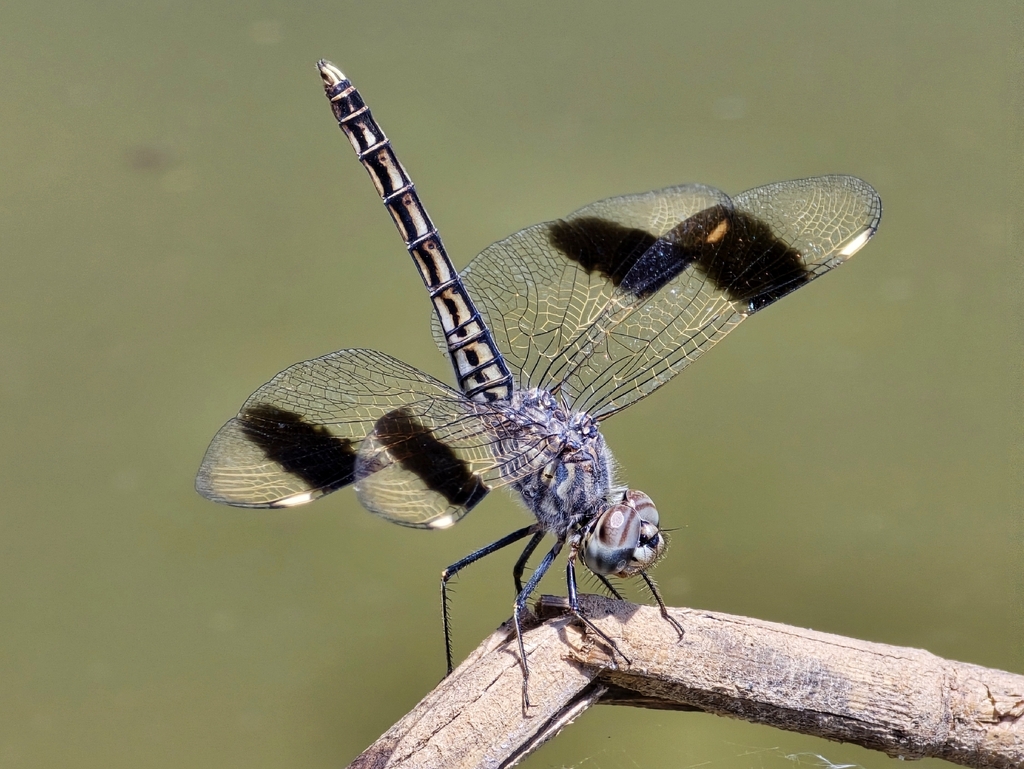
The Northern Banded Groundling is 25 to 34 mm long with hind-wing spans of 20 to 26 mm. It lives low over slow rivers, lakes and still waters in open areas, preferring sandy or muddy bottoms. It has spread into southern Europe, first recorded in Portugal in 1957 and now found in Spain, Italy, Sardinia, Corsica and Sicily.
Source: Wikipedia
How to recognize it
Both sexes have a pale cream pterostigma and striped eyes.
Source: Wikipedia
Size
Body length ranges from 25 to 34 mm (0.98 to 1.34 in). Hind-wing span is 20 to 26 mm (0.79 to 1.02 in).
Source: Wikipedia
Life cycle
It was once considered the same species as B. leucosticta.
Source: Wikipedia
When you see it
Where it occurs, it can be the most common Odonata species.
Source: Wikipedia
Where it comes from
Originally African, it has colonised southern Europe, first recorded in Portugal in 1957 and now present in Spain, Italy, Sardinia, Corsica and Sicily.
Source: Wikipedia
Lookalikes
It was previously lumped with B. leucosticta, but males differ in vein colour, genital lobe shape and the ventral structure of segment 8 where the two species overlap.
Source: Wikipedia
Questions people ask
How can I tell the Northern Banded Groundling apart from similar dragonflies?
Males have pale wing bands that darken with age, and they differ from B. leucosticta in vein colour, genital lobe shape and the ventral structure of segment 8.
Source: Wikipedia
What size is the Northern Banded Groundling?
It measures 25 to 34 mm in length with hind-wing spans of 20 to 26 mm.
Source: Wikipedia
Same family (Libellulidae)

Sources
- Wikipedia: https://en.wikipedia.org/wiki/Brachythemis_impartita
Look it up elsewhere: GBIF · iNaturalist · BugGuide · Wikipedia
Text written 2026-10-23 from the sources above and checked sentence by sentence against them. Data fetched 2026-10-22.