 Bug FAQ
Narrow-winged Mantis
Tenodera angustipennis · Order: Mantodea · Family: Mantidae
Also called: Asian mantis, Japanese Mantis
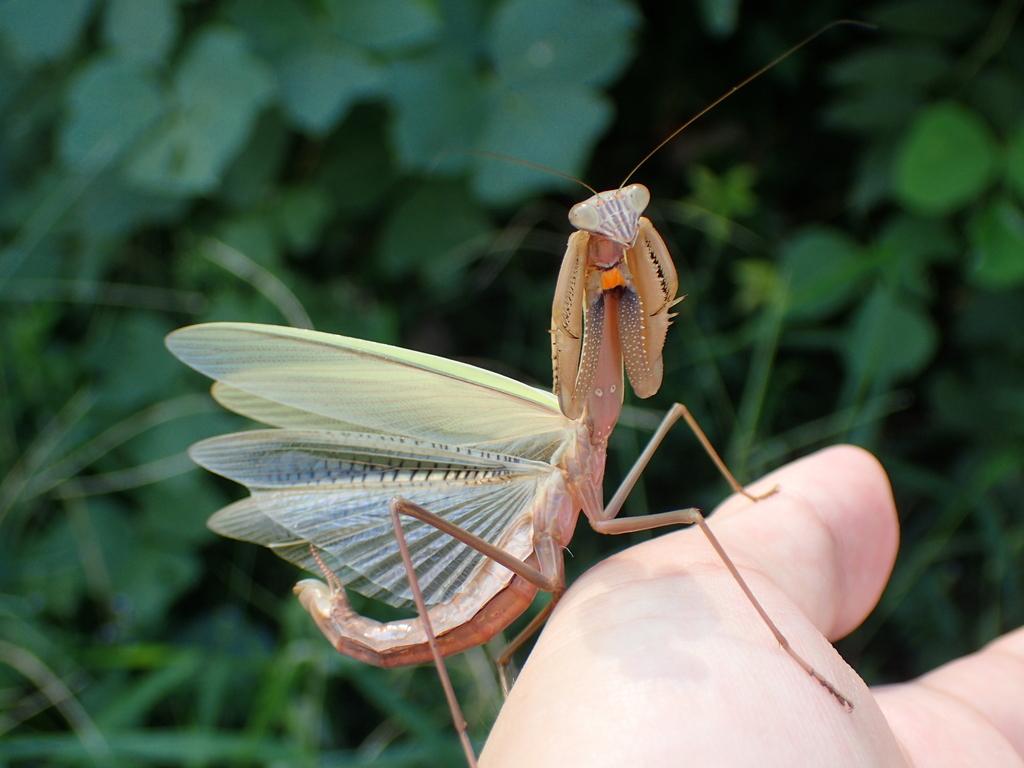
Males are 65 to 80 mm long and females 68 to 85 mm long. It is usually brown or green, with a longer pronotum and narrower wings than the similar Chinese mantis. The hind wings have a brown streak on each transparent wing, unlike the fully patterned brown wings of the Chinese mantis.
Source: Wikipedia
How to recognize it
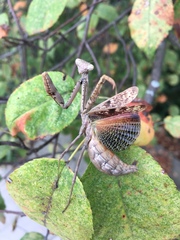
Each transparent hind wing shows a brown, patterned streak, while Tenodera sinensis has completely brown patterned hind wings.
Source: Wikipedia
Size
Males measure 65 to 80 mm and females 68 to 85 mm in length.
Source: Wikipedia
Where it lives
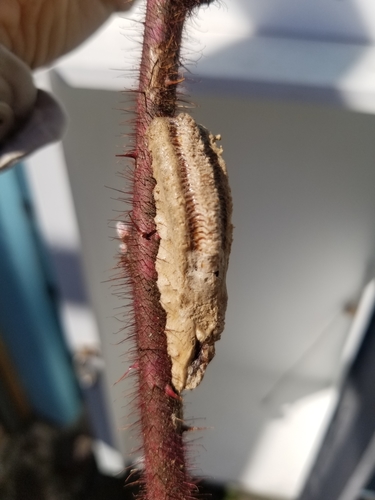
Egg cases are usually attached to shrub twigs, tall herb stems, tree trunks, or fence posts. In some regions it is as common as the Chinese mantis.
Source: Wikipedia
Where it comes from
It is native to Asia and nearby parts of Oceania.
Source: Wikipedia
Lookalikes
Adults of Tenodera angustipennis and Tenodera sinensis are easiest to tell apart when placed side by side. Its egg cases are elongated (40 to 60 mm long, ~14 mm wide) and can be mistaken for those of Stagmomantis carolina.
Source: Wikipedia
Where it is found in the US
Recorded in 20 of 51 states and DC. Most records: Virginia, Maryland, New York, Pennsylvania, New Jersey, Delaware, Hawaii, North Carolina.
Darker = more records. Counts are museum and citizen-science records, not population size.
Source: GBIF
Status: introduced in United States. Source: iNaturalist
Months it is reported in the US
Source: GBIF
More photos
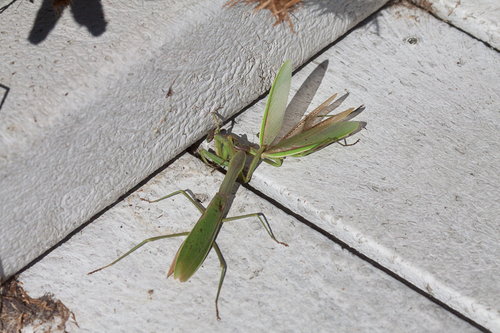
Same family (Mantidae)
Sources
- Wikipedia: https://en.wikipedia.org/wiki/Tenodera_angustipennis
Look it up elsewhere: GBIF · iNaturalist · BugGuide · ITIS · Wikipedia
Text written 2026-10-22 from the sources above and checked sentence by sentence against them. Data fetched 2026-10-22.