 Bug FAQ
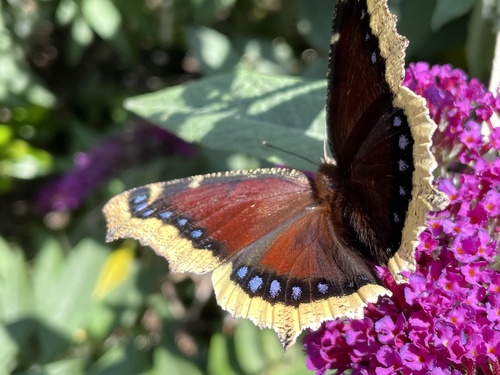
Mourning Cloak
Nymphalis antiopa · Order: Lepidoptera · Family: Nymphalidae
Also called: Camberwell Beauty, Mourningcloak Butterfly, Spiny Elm Caterpillar
Source: Wikipedia
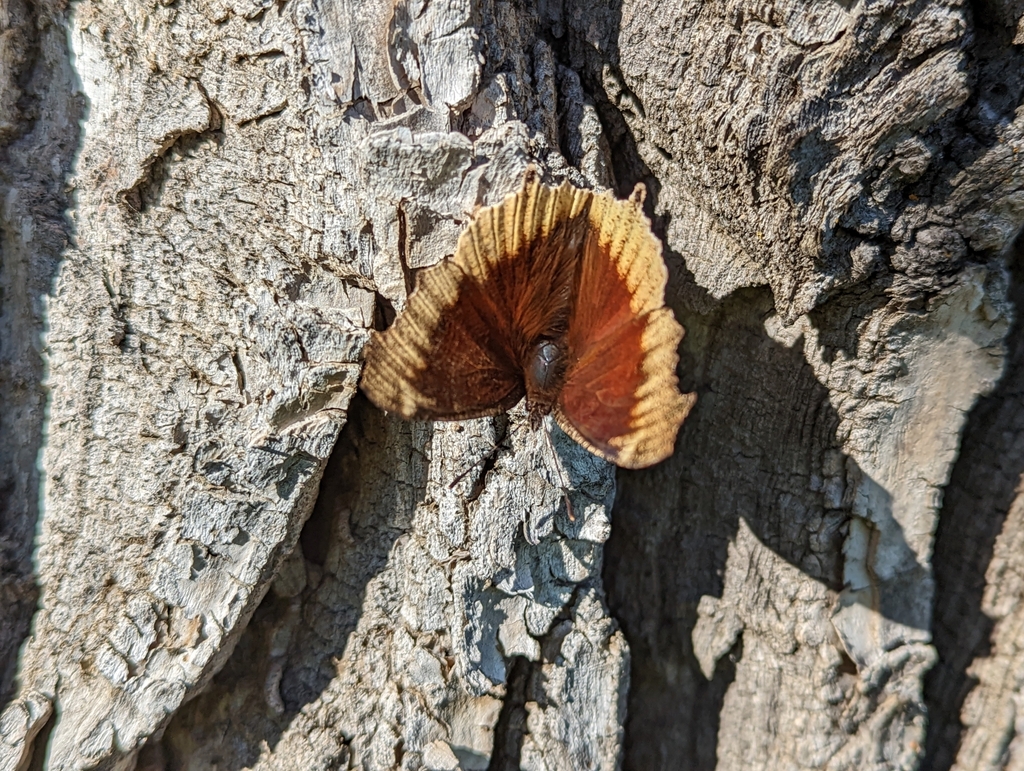
The caterpillars are black with a line of eight reddish-orange dots and have red-tipped spikes on the pupae. Fully grown larvae reach about two inches, and the pupae are typically 0.8-1.1 inches long. They live in hardwood forests across the northern hemisphere and hibernate as adults in winter, emerging early in spring.
Source: Wikipedia
How to recognize it
Caterpillars are black with a row of eight reddish-orange spots along the back.
Source: Wikipedia
Size
Mature caterpillars grow to about two inches in length. Pupae average 0.8 inches but can exceed 1.1 inches.
Source: Wikipedia
Is it a pest in the house?
Large groups of larvae can defoliate ornamental trees in parks, nurseries, and plantations.
Source: Wikipedia
Where it lives
They are most common in hardwood forests but can appear in many habitats, even as far north as South America.
Source: Wikipedia
What it eats
Caterpillars feed on young willow and poplar leaves, which they can completely strip from a tree.
Source: Wikipedia
Life cycle
They undergo complete metamorphosis: egg, five larval stages, pupa, then adult. The pupal stage lasts about fifteen days, during which the larva hangs from grass stems in a tan or gray chrysalis.
Source: Wikipedia
When you see it
Adults hibernate through winter and are often the first butterflies to fly in early spring.
Source: Wikipedia
Where it comes from
The species is native to Eurasia and North America and is found throughout the northern hemisphere.
Source: Wikipedia
Lookalikes
Three North American subspecies exist: N. a. hyperborea, N. a. lintnerii, and N. a. thomsoni. In Britain the butterfly is called the Camberwell beauty, or in Welsh 'y fantell alar'.
Source: Wikipedia
Where it is found in the US
Recorded in 50 of 51 states and DC. Most records: California, New York, Vermont, Illinois, Michigan, Minnesota, Colorado, Arizona.
Darker = more records. Counts are museum and citizen-science records, not population size.
Source: GBIF
Status: native in North America; native in United States; native in Canada. Source: iNaturalist
Months it is reported in the US
Source: GBIF
More photos
Questions people ask
Can they damage my garden trees?
Yes, large groups can strip the leaves off young willow, poplar, and ornamental trees.
Source: Wikipedia
When are adult mourning cloaks active?
Adults emerge from winter hibernation early in spring, often before the snow has melted.
Source: Wikipedia
Same family (Nymphalidae)






Sources
- Wikipedia: https://en.wikipedia.org/wiki/Nymphalis_antiopa
Look it up elsewhere: GBIF · iNaturalist · BugGuide · ITIS · Wikipedia
Text written 2026-10-22 from the sources above and checked sentence by sentence against them. Data fetched 2026-10-22.