 Bug FAQ
Mormon Fritillary
Speyeria mormonia · Order: Lepidoptera · Family: Nymphalidae
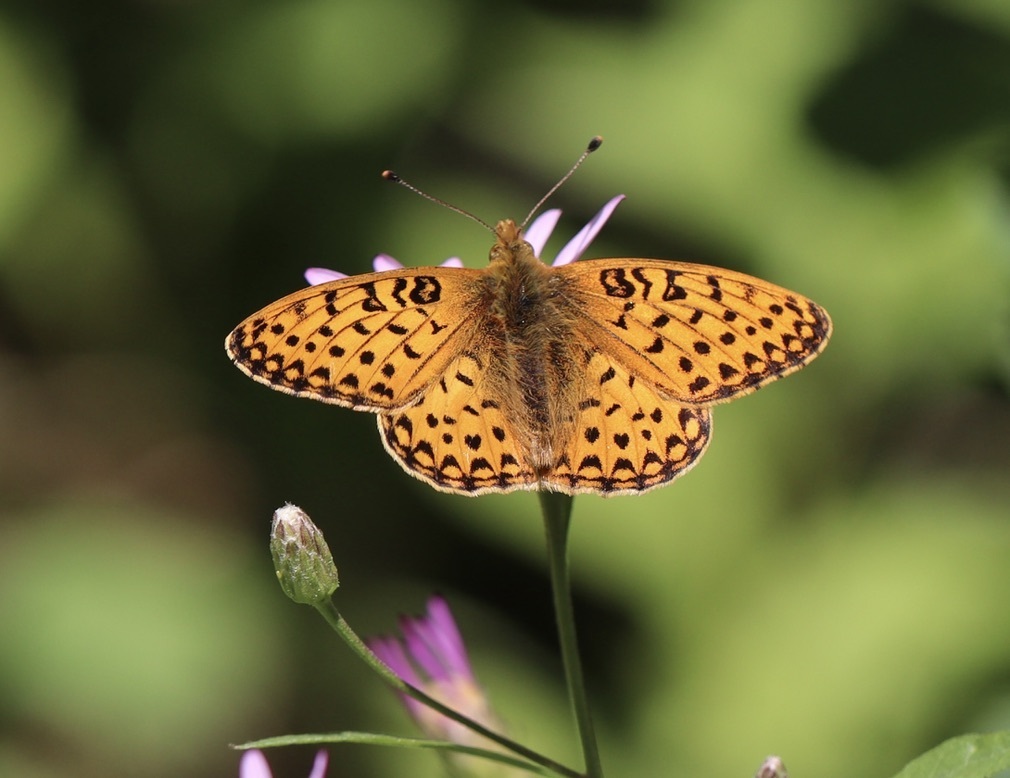
The Mormon Fritillary is a relatively small fritillary with orange wings marked by black spots and a green-tinged hindwing with silver streaks. Females have a wingspan of about 25 to 27 mm and males 23 to 26 mm, though size can vary among populations. It lives in western North America, occupying rocky slopes, moist meadows, open grasslands and pine-forest clearings, and relies on violet plants for larval food and nectar sources for adults.
Source: Wikipedia
How to recognize it
It is small compared with other fritillaries. The upper wings are orange with black patches; the underside of the hindwing has a green tint and light silver streaks.
Source: Wikipedia
Size
Female wingspan averages 25 to 27 mm; males are slightly smaller at 23 to 26 mm. These measurements come from a Colorado population and may differ in other groups.
Source: Wikipedia
Where it lives
Their numbers depend on suitable climate and the availability of violet nectar.
Source: Wikipedia
What it eats
Violet species are the host plants for the caterpillars. Adult males and older females also feed at mud puddles and sip nectar from Compositae flowers.
Source: Wikipedia
Life cycle
Males emerge from the pupa at least two weeks before females (protandry). Females pupate later, likely to accumulate more nutrients for reproduction.
Source: Wikipedia
When you see it
Male flight peaks 2 to 3 weeks before the female peak.
Source: Wikipedia
Where it comes from
The species is found throughout western North America, including the United States and Canada. Four subspecies occur in Canada from the Yukon to British Columbia.
Source: Wikipedia
Where it is found in the US
Recorded in 16 of 51 states and DC. Most records: Colorado, Wyoming, Washington, California, Idaho, Utah, Montana, Oregon.
Darker = more records. Counts are museum and citizen-science records, not population size.
Source: GBIF
Months it is reported in the US
Source: GBIF
More photos

Questions people ask
When can I see adult Mormon Fritillaries?
Adults fly from mid-July to early September, with males appearing a few weeks earlier.
Source: Wikipedia
Where does the Mormon Fritillary live?
It is native to western North America, found in the United States and Canada, including several Canadian provinces.
Source: Wikipedia
How big is a Mormon Fritillary?
Females have a wingspan of about 25 to 27 mm and males about 23 to 26 mm.
Source: Wikipedia
Same family (Nymphalidae)






Sources
- Wikipedia: https://en.wikipedia.org/wiki/Speyeria_mormonia
Look it up elsewhere: GBIF · iNaturalist · BugGuide · ITIS · Wikipedia
Text written 2026-10-23 from the sources above and checked sentence by sentence against them. Data fetched 2026-10-23.