 Bug FAQ
Melissodes verbesinarum
Melissodes verbesinarum · Order: Hymenoptera · Family: Apidae
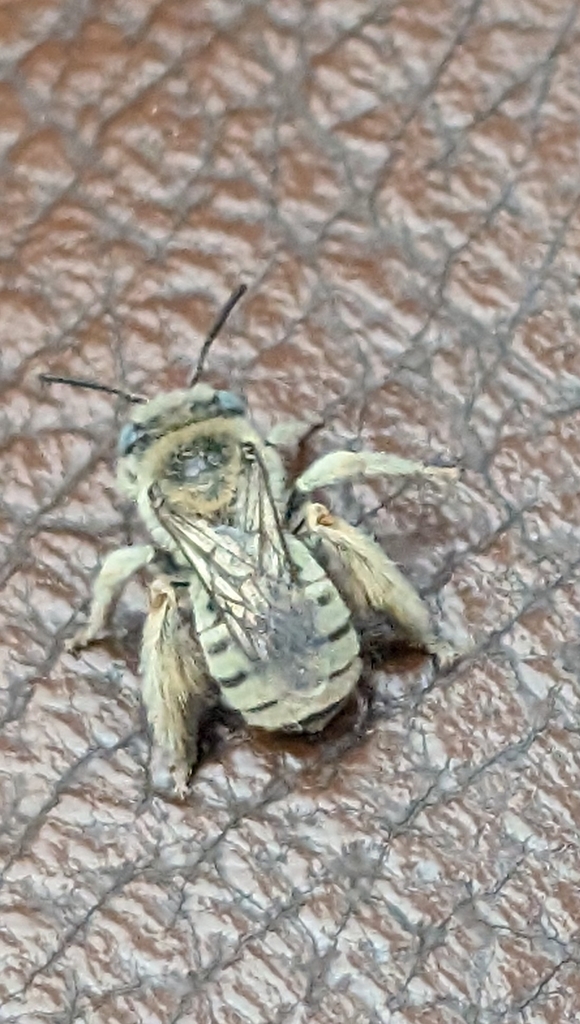
Females are sturdier than other Melissodes and have distinctive dark hairs on the inner side of the hind-tarsal basal joint, a bright rusty underside on the flagellum after the first two segments, a broad white band on the second abdominal segment, paler thorax hairs near the head, and pale sea-green eyes. They live in the southwestern United States and central Mexico and feed on sunflower nectar without pollinating the flowers. They can be confused with a small Melissodes pallidicincta, but a noticeably narrower face sets them apart.
Source: Wikipedia
How to recognize it
Look for darker hairs on the inner side of the hind-tarsal basal joint, a bright rusty underside on the flagellum after the first two segments, a broad white band on the second abdominal segment, paler thorax hairs near the head, and pale sea-green eyes.
Source: Wikipedia
Size
Females are more robust than other Melissodes species.
Source: Wikipedia
Where it lives
Found in the southwestern United States and central Mexico.
Source: Wikipedia
What it eats
Adults visit Helianthus annuus (sunflower) for nectar but do not pollinate the plant.
Source: Wikipedia
Where it comes from
Native to the southwestern United States and central Mexico.
Source: Wikipedia
Lookalikes
It may be mistaken for a small Melissodes pallidicincta, but it has a much narrower face.
Source: Wikipedia
Where it is found in the US
Recorded in 10 of 51 states and DC. Most records: Arizona, California, New Mexico, Nevada, Utah, Colorado, Texas, Kansas.
Darker = more records. Counts are museum and citizen-science records, not population size.
Source: GBIF
Status: native in North America; native in United States. Source: iNaturalist
Months it is reported in the US
Source: GBIF
Questions people ask
How can I tell this bee apart from similar species?
Check the face width; this species has a noticeably narrower face than the similar Melissodes pallidicincta.
Source: Wikipedia
Where is Melissodes verbesinarum found?
It occurs in the southwestern United States and central Mexico.
Source: Wikipedia
What plants does it visit?
It feeds on nectar from sunflowers (Helianthus annuus) without pollinating them.
Source: Wikipedia
What are its distinguishing physical features?
Look for darker hairs on the inner side of the hind-tarsal basal joint, a bright rusty underside on the flagellum after the first two segments, a broad white band on the second abdominal segment, paler thorax hairs near the head, and pale sea-green eyes.
Source: Wikipedia
Same family (Apidae)


Sources
- Wikipedia: https://en.wikipedia.org/wiki/Melissodes_verbesinarum
Look it up elsewhere: GBIF · iNaturalist · BugGuide · ITIS · Wikipedia
Text written 2026-10-24 from the sources above and checked sentence by sentence against them. Data fetched 2026-10-24.