 Bug FAQ
Mazarine Blue
Cyaniris semiargus · Order: Lepidoptera · Family: Lycaenidae
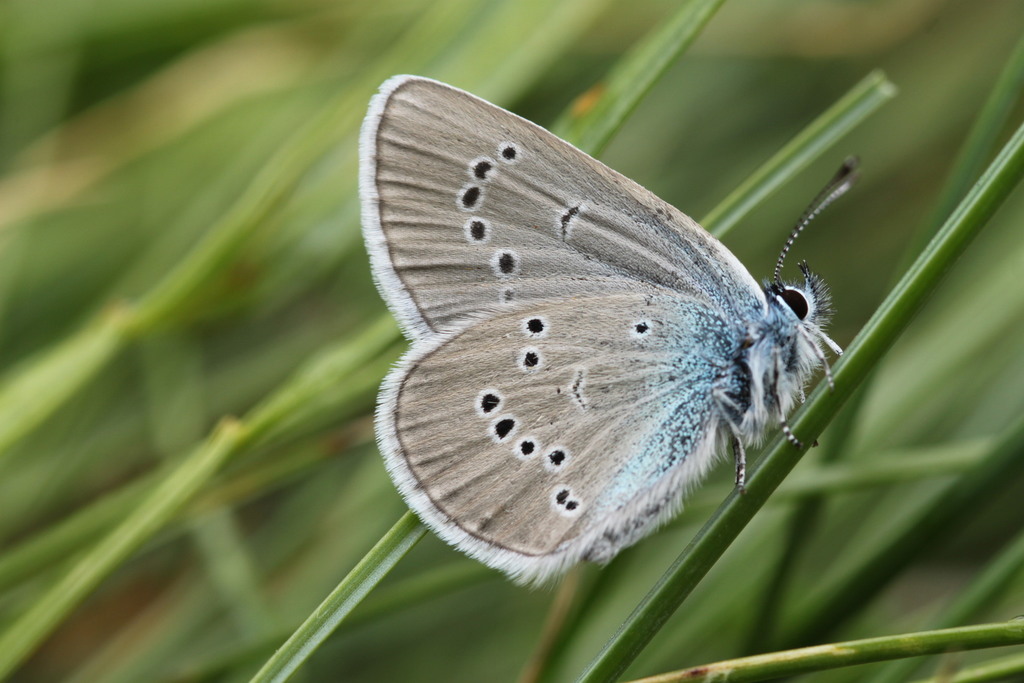
The Mazarine blue is a small butterfly with a wingspan of about 32 to 38 mm. It lives in unfertilized meadows, pastures and damp grassy areas up to 2200 m, and is found across continental Europe to Siberia. Caterpillars feed on various clovers and related legumes, and the species has one generation per year, overwintering as a young larva.
Source: Wikipedia
How to recognize it
Males have deep blue upper wings with black borders and white fringes; females are brown on the upper side. Both sexes have a grey-ochre underside with black spots edged in white and blue scaling near the base, and lack orange markings. The body is dark violet or brown, and there are no orange markings.
Source: Wikipedia
Size
Wingspan ranges from 32 to 38 mm for both males and females.
Source: Wikipedia
Where it lives
Found in meadows, pastures, grasslands and flowery damp areas, preferring sites that are not fertilized or used for fodder.
Source: Wikipedia
What it eats
Caterpillars mainly eat red clover and other Trifolium species, as well as Vicia cracca, Anthyllis, Genista and Melilotus.
Source: Wikipedia
Life cycle
The species has one brood per year and overwinters as a young larva.
Source: Wikipedia
When you see it
Adults are on the wing from May through August.
Source: Wikipedia
Lookalikes
It resembles Cupido minimus, but the pattern of black spots on the underside of the hindwing forms an obtuse angle in Mazarine blue versus an acute angle in C. minimus. It has also been compared to the common blue and Grecian Cyaniris bellis, which has orange markings.
Source: Wikipedia
Same family (Lycaenidae)

Sources
- Wikipedia: https://en.wikipedia.org/wiki/Cyaniris_semiargus
Look it up elsewhere: GBIF · iNaturalist · BugGuide · Wikipedia
Text written 2026-10-22 from the sources above and checked sentence by sentence against them. Data fetched 2026-10-22.