 Bug FAQ
Marbled White
Melanargia galathea · Order: Lepidoptera · Family: Nymphalidae
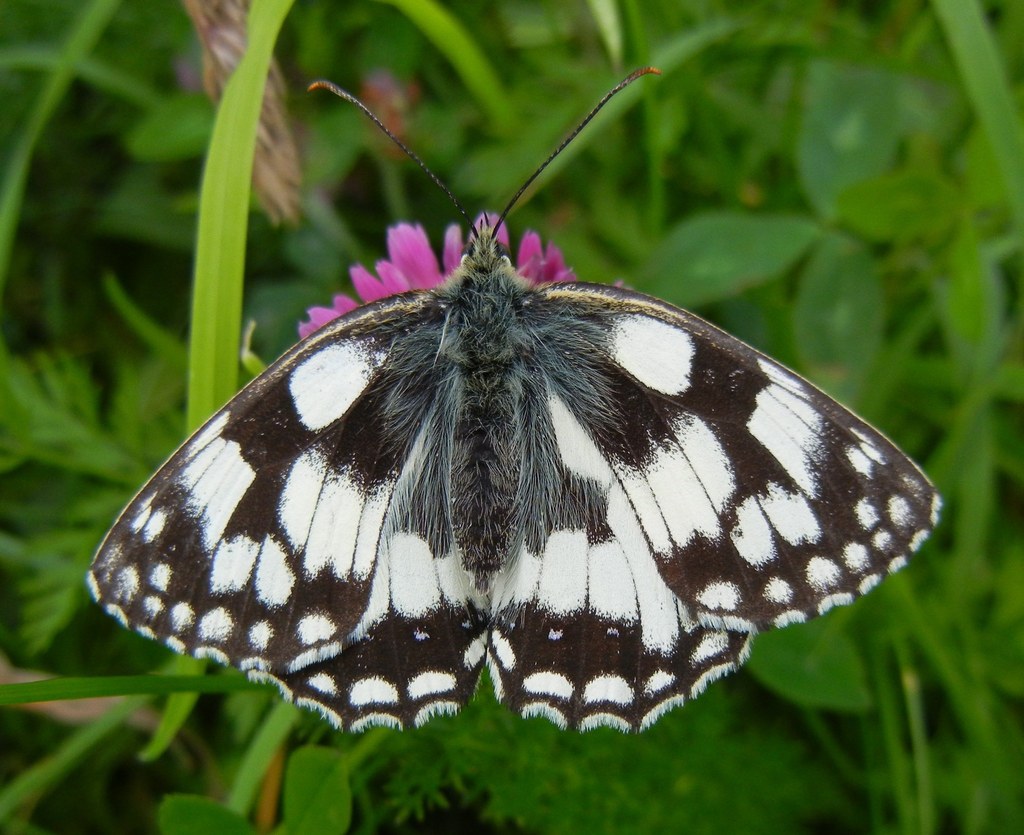
The Marbled White has a wingspan of about 46 to 56 mm and shows gray-black or dark brown checkered markings on the upper wing surfaces, with lighter gray or brown on the underside. It lives in forest clearings, meadow edges and unimproved grasslands up to about 1,700 m, and is common on the South Downs in southern Britain.
Source: Wikipedia
How to recognize it
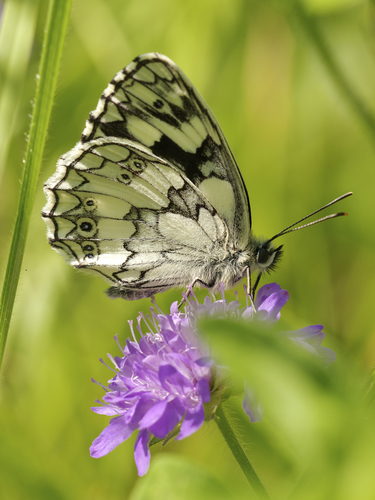
The underside mirrors the upper side but the pattern appears in light gray or light brown.
Source: Wikipedia
Size
Wingspan ranges from 46 to 56 mm (about 1.8 to 2.2 in).
Source: Wikipedia
Where it lives
Found in forest clearings, edges, meadows and steppe up to 1,500 to 1,700 m altitude. Common in unimproved grasslands of southern Britain, especially the South Downs.
Source: Wikipedia
What it eats
Caterpillars feed on a variety of grasses. After hatching the larvae immediately hibernate and resume feeding the following spring when fresh grass growth appears.
Source: Wikipedia
Life cycle
Eggs are laid loosely among grass stems during brief perches on the plants. Pupation occurs at ground level inside a loose cocoon.
Source: Wikipedia
When you see it
Adults are on the wing from early June through early September.
Source: Wikipedia
Where it comes from
An isolated population exists in Japan.
Source: Wikipedia
Lookalikes
It resembles the Iberian marbled white (Melanargia lachesis), which replaces it in Spain and southern France.
Source: Wikipedia
More photos
Same family (Nymphalidae)






Sources
- Wikipedia: https://en.wikipedia.org/wiki/Melanargia_galathea
Look it up elsewhere: GBIF · iNaturalist · BugGuide · Wikipedia
Text written 2026-10-22 from the sources above and checked sentence by sentence against them. Data fetched 2026-10-22.