 Bug FAQ
Manuka beetle
Pyronota festiva · Order: Coleoptera · Family: Scarabaeidae
Also called: Kekerewai manuka chafer
Source: Wikipedia
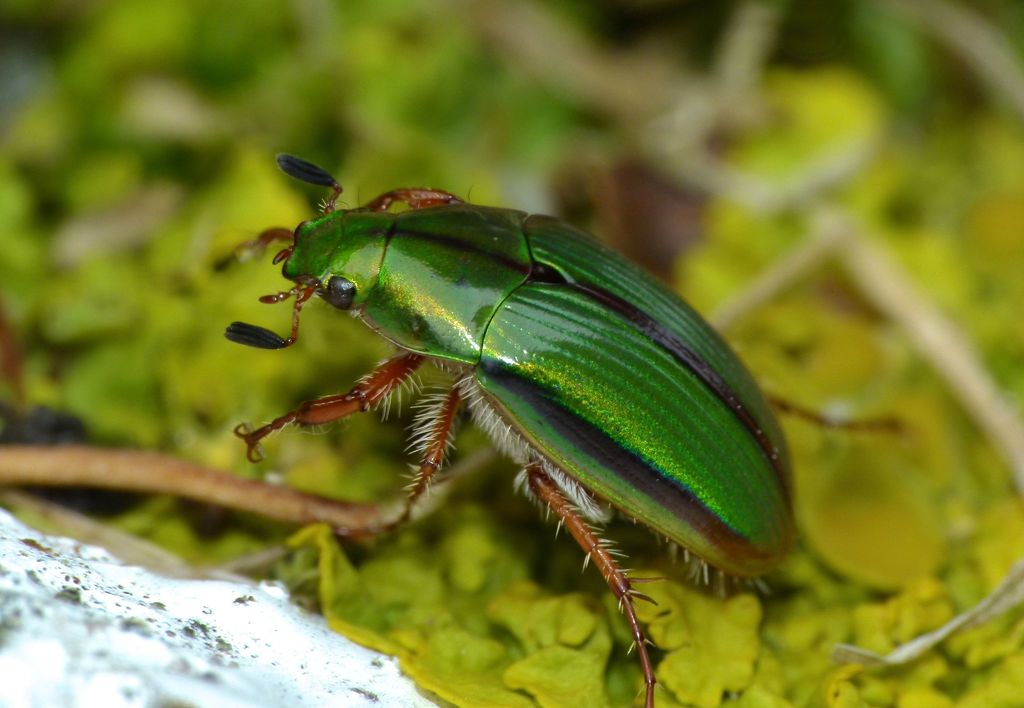
The mānuka beetle is a bright green scarab about 9 mm long, though individuals can range from 3 to 25 mm. Adults appear for a few weeks in late spring and early summer, feeding on mānuka leaves and grass roots, and are considered a pasture pest in New Zealand. Control methods include bio-control with microbes and crushing larvae by heavy livestock stocking on moist soil.
Source: Wikipedia
How to recognize it
Its back is bright green with blue and yellow patches and a dark longitudinal stripe that can be brown or yellow.
Source: Wikipedia
Size
Length varies from 3 mm to 25 mm, most commonly around 9 mm.
Source: Wikipedia
Is it a pest in the house?
In some regions it is regarded as a pasture pest.
Source: Wikipedia
How to get rid of it
Research has explored bacterial and fungal bio-control agents to reduce populations. Heavy livestock stocking on moist winter soils crushes larvae, dramatically lowering numbers.
Source: Wikipedia
Where it lives
It lives in grassy and vegetated areas, which cover most of New Zealand’s landscape.
Source: Wikipedia
What it eats
Adults feed on mānuka tree foliage. They also consume grass roots in agricultural lands.
Source: Wikipedia
Life cycle
The beetle has a two-year life cycle with three larval stages. Eggs are laid in January; larvae spend their first winter as early instars and the second winter as third instars.
Source: Wikipedia
When you see it
Adults are present for a few weeks in late spring and early summer each year. They are more active on sunny days than on overcast or at night.
Source: Wikipedia
Where it comes from
It is endemic to New Zealand and found widely across the country.
Source: Wikipedia
More photos

Questions people ask
How can I get rid of mānuka beetles?
Use bio-control agents such as specific bacteria or fungi, or stock pastures heavily in winter on wet soil to crush the larvae.
Source: Wikipedia
When are adult mānuka beetles active?
Adults appear for a few weeks in late spring and early summer and are most active on sunny days.
Source: Wikipedia
What do adult mānuka beetles eat?
They feed on the leaves of mānuka trees and on grass roots in agricultural areas.
Source: Wikipedia
Same family (Scarabaeidae)
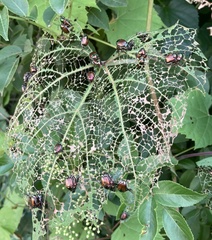 Japanese BeetlePopillia japonicaDamages trees, gardens or crops
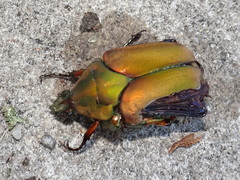 Common Green June BeetleCotinis nitidaDamages trees, gardens or crops
 Phyllophaga crinitaPhyllophaga crinitaDamages trees, gardens or crops
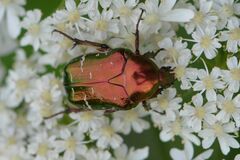 European Rose ChaferCetonia aurata
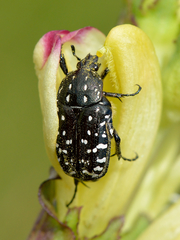 Mediterranean Spotted ChaferOxythyrea funestaDamages trees, gardens or crops
 Oriental BeetleExomala orientalisDamages trees, gardens or crops
Sources
- Wikipedia: https://en.wikipedia.org/wiki/Pyronota_festiva
Look it up elsewhere: GBIF · iNaturalist · BugGuide · Wikipedia
Text written 2026-10-23 from the sources above and checked sentence by sentence against them. Data fetched 2026-10-23.