 Bug FAQ
Lixus iridis
Lixus iridis · Order: Coleoptera · Family: Curculionidae


Adults are 12 to 17 mm long and have an oblong, yellow-grey body. They show three faint grey grooves on the prothorax and abdomen, thin elbowed antennae on a straight rostrum, and slender legs with slightly thickened femurs. Lixus iridis is a European weevil that lays its eggs in June.
Source: Wikipedia
How to recognize it
It has thin, elbowed antennae placed on the upper third of a straight, cylindrical rostrum as long as the prothorax. Legs are thin with slightly thickened femurs.
Source: Wikipedia
Size
Adults grow to 12 to 17 mm in length.
Source: Wikipedia
Life cycle
Eggs are laid in June.
Source: Wikipedia
When you see it
Egg-laying occurs in June.
Source: Wikipedia
Where it comes from
This species is found in Europe.
Source: Wikipedia
More photos


Questions people ask
Same family (Curculionidae)
 Green Immigrant Leaf WeevilPolydrusus formosusDamages trees, gardens or crops
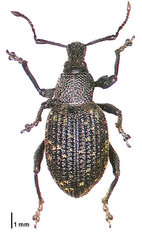 Black Vine WeevilOtiorhynchus sulcatusDamages trees, gardens or crops
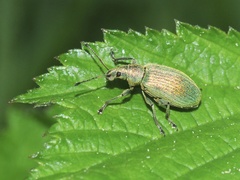 Nettle weevilPhyllobius pomaceusDamages trees, gardens or crops
 Asian Oak WeevilCyrtepistomus castaneusDamages trees, gardens or crops
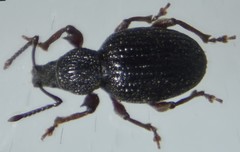 Strawberry Root WeevilOtiorhynchus ovatusDamages trees, gardens or crops
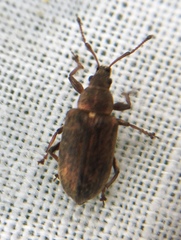 Common Leaf WeevilPhyllobius pyriDamages trees, gardens or crops
Sources
- Wikipedia: https://en.wikipedia.org/wiki/Lixus_iridis
Look it up elsewhere: GBIF · iNaturalist · BugGuide · Wikipedia
Text written 2026-10-23 from the sources above and checked sentence by sentence against them. Data fetched 2026-10-22.