 Bug FAQ
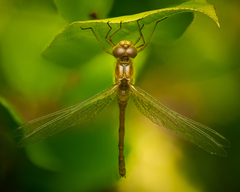
Little Scarlet
Crocothemis sanguinolenta · Order: Odonata · Family: Libellulidae
Also called: Small Scarlet, Slim Scarlet-darter

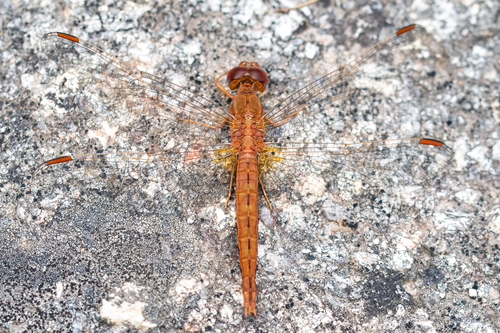
Mature males have a narrow abdomen and short red pterostigmata, and the side carinae of abdominal segments 3-7 usually show black dashes. It can be mistaken for the similar Crocothemis erythraea, but the latter has a wider abdomen, unmarked side carinae and longer, less brightly coloured pterostigmata.
Source: Wikipedia
Where it comes from
Its range includes Africa south of the Sahara (including Madagascar), the Levant, and the southern Arabian Peninsula.
Source: Wikipedia
Lookalikes
It is easily confused with Crocothemis erythraea, but differs by having a narrower abdomen (≤3 mm), black-dashed side carinae on S3-S7, and short red pterostigmata, whereas C. erythraea has a wider abdomen (≥3.5 mm), generally unmarked carinae, and longer, less brightly coloured pterostigmata.
Source: Wikipedia
More photos
Questions people ask
How can I tell Little Scarlet apart from similar species?
Look for a narrow abdomen, short red pterostigmata, and black dashes on the side carinae of abdominal segments 3-7; the similar Crocothemis erythraea has a wider abdomen, unmarked carinae and longer, duller pterostigmata.
Source: Wikipedia
Same family (Libellulidae)


Sources
- Wikipedia: https://en.wikipedia.org/wiki/Crocothemis_sanguinolenta
Look it up elsewhere: GBIF · iNaturalist · BugGuide · Wikipedia
Text written 2026-10-23 from the sources above and checked sentence by sentence against them. Data fetched 2026-10-22.