 Bug FAQ
Limodromus assimilis
Limodromus assimilis · Order: Coleoptera · Family: Carabidae
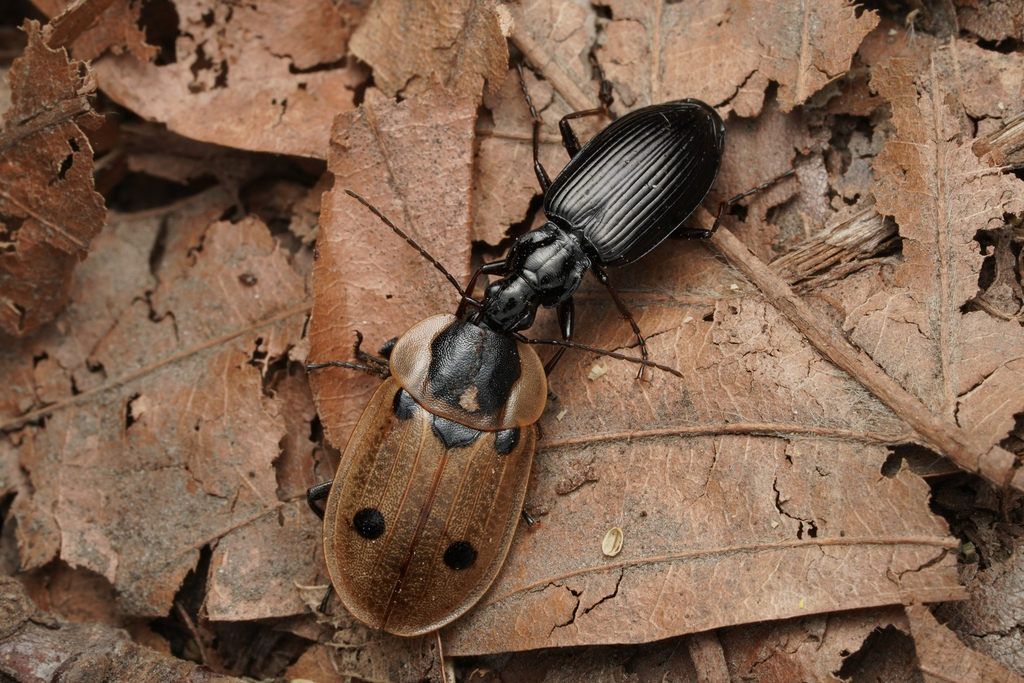
It lives under bark, moss, withered leaves and near water or beaches, and is found across most of Europe and into Asia, including Norway.
Source: Wikipedia
How to recognize it
The beetle’s legs are brown-black with darker sections, and its antennae are also brown-black with fine hairs on the fourth segment and longer bristles at the tip. Its elytra have deep, clear grooves; the third groove from the middle has three brush points and a recess with a stiff hair. The third antennal segment is smooth and lacks short hairs, a detail visible only with magnification.
Source: Wikipedia
Size
Adults measure between 8.7 and 12.3 mm in length.
Source: Wikipedia
Where it lives
It is found under tree bark, in moss, among withered leaves, and commonly along waterways and beaches.
Source: Wikipedia
What it eats
Adults are nocturnal predators that hunt other small animals. The larvae are also predatory, living in the top layer of soil.
Source: Wikipedia
Life cycle
It undergoes complete metamorphosis (holometabolous development). The larval stage looks very different from the adult, with a pupal stage in between where major changes occur.
Source: Wikipedia
Where it comes from
Its range covers most of Europe, extending eastward into Asia, and it is present in Norway.
Source: Wikipedia
Lookalikes
It belongs to the subfamily Platyninae within the ground-beetle family.
Source: Wikipedia
Where it is found in the US
Recorded in 3 of 51 states and DC. Most records: Florida, Pennsylvania, California.
Darker = more records. Counts are museum and citizen-science records, not population size.
Source: GBIF
More photos

Questions people ask
How can I identify Limodromus assimilis?
Look for a uniformly black ground beetle about 9-12 mm long, with deep elytral grooves, a sharply tapered pronotum, brown-black legs with darker tips, and antennae that have fine hairs on the fourth segment and a smooth third segment.
Source: Wikipedia
Where might I find Limodromus assimilis?
It lives under bark, moss, and withered leaves, and is often found near streams, rivers, or beaches.
Source: Wikipedia
What does Limodromus assimilis eat?
Both adults and larvae are predators, feeding on other small animals and insects.
Source: Wikipedia
Same family (Carabidae)


Sources
- Wikipedia: https://en.wikipedia.org/wiki/Platynus_assimilis
Look it up elsewhere: GBIF · iNaturalist · BugGuide · Wikipedia
Text written 2026-10-23 from the sources above and checked sentence by sentence against them. Data fetched 2026-10-22.