 Bug FAQ
Lime Blue
Chilades lajus · Order: Lepidoptera · Family: Lycaenidae
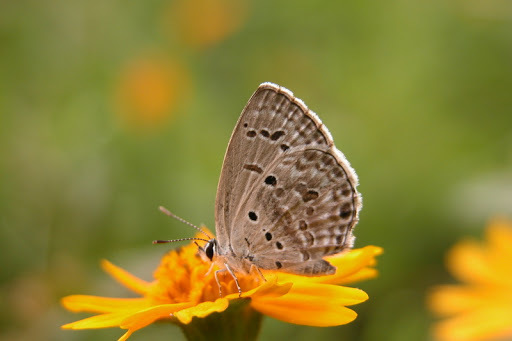
The adult Lime Blue measures about 0.44 inches long (seven-sixteenths of an inch) and the male shows a bluish-purple top side. Its forewing edges have a thin dark brown line with pale blue near the base, and the wing fringe is brown with a white tip. It lives in many parts of South and Southeast Asia, attaching to the undersides of its host plant leaves.
Source: Wikipedia
How to recognize it
Males have a bluish-purple upperside, and the forewing shows pale blue near the base with a narrow dark brown border; the wing fringe is brown with a white outer edge.
Source: Wikipedia
Size
Full-grown adults are about seven-sixteenths of an inch long (roughly 0.44 inches).
Source: Wikipedia
Where it lives
The butterfly rests on the underside of its food-plant leaves.
Source: Wikipedia
What it eats
The caterpillars feed on the plant Glycosmis arborea.
Source: Wikipedia
Life cycle
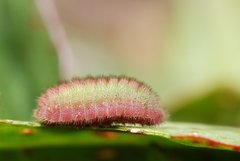
The larva is plain-coloured with no obvious markings. The pupa is green and has faint brown spots in rows on the top and sides.
Source: Wikipedia
When you see it
Adults are common in Calcutta during the rainy season. They look similar to the wet-season form but have a slightly paler upper side and a large brown patch on the underside of the hindwing.
Source: Wikipedia
Lookalikes
They can be confused with the wet-season brood, though the Lime Blue is a bit paler on the upperside.
Source: Wikipedia
Same family (Lycaenidae)





Sources
- Wikipedia: https://en.wikipedia.org/wiki/Chilades_lajus
Look it up elsewhere: GBIF · iNaturalist · BugGuide · Wikipedia
Text written 2026-10-22 from the sources above and checked sentence by sentence against them. Data fetched 2026-10-22.