 Bug FAQ
Lesser Spiny Stick-insect
Micrarchus hystriculeus · Order: Phasmida · Family: Phasmatidae
Also called: The Lesser Spiny Stick Insect

Females grow larger than 56 mm and have longer mid and hind legs than males, which stay under 50 mm long. It lives in lowland trees, can also be found in alpine areas, and feeds on native plants such as mānuka, ribbonwood and Hoheria.
Source: Wikipedia
How to recognize it
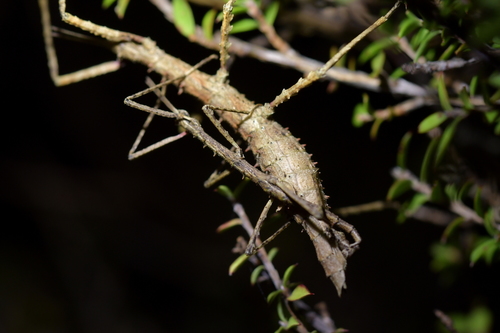
The insect is small, brown, with two rows of spines on its back and spiky flangers on its legs. Eggs are longer than they are wide and lack spine-like setae.
Source: Wikipedia
Size
Adult females exceed 56 mm in length and have proportionally longer mid and hind legs to support larger abdomens. Males are smaller, measuring less than 50 mm long.
Source: Wikipedia
Where it lives
The species also occurs in alpine areas but is less cold-hardy than other Micrarchus species.
Source: Wikipedia
What it eats
Micrarchus hystriculeus feeds on the leaves of mānuka, ribbonwood and Hoheria.
Source: Wikipedia
Life cycle
Males engage in grappling contests, trying to dislodge rivals that are mounted on females. Pairs stay together for a prolonged period, likely to guard the mate. Populations show a male-biased sex ratio, and unpaired females are rarely seen.
Source: Wikipedia
More photos
Questions people ask
How large do females get compared to males?
Females grow beyond 56 mm, while males stay under 50 mm.
Source: Wikipedia
What plants does Micrarchus hystriculeus eat?
It feeds on mānuka, ribbonwood and Hoheria leaves.
Source: Wikipedia
Where is this stick insect usually found?
It lives in lowland trees and can also be found in alpine areas, though it tolerates cold less well than its relatives.
Source: Wikipedia
Do males fight over females?
Yes, males grapple to try to remove rivals that are already mounted on a female.
Source: Wikipedia
Same family (Phasmatidae)
 Smooth Stick InsectClitarchus hookeri
 Margin-winged Stick InsectCtenomorpha marginipennisDamages trees, gardens or crops
 Prickly Stick InsectAcanthoxyla prasinaDamages trees, gardens or crops
 Spur Legged PhasmidDidymuria violescens
 Spiny Leaf insectExtatosoma tiaratumCan irritate skin
 Titan Stick InsectAcrophylla titan
Sources
- Wikipedia: https://en.wikipedia.org/wiki/Micrarchus_hystriculeus
Look it up elsewhere: GBIF · iNaturalist · BugGuide · Wikipedia
Text written 2026-10-23 from the sources above and checked sentence by sentence against them. Data fetched 2026-10-23.