 Bug FAQ
Large Tortoiseshell
Nymphalis polychloros · Order: Lepidoptera · Family: Nymphalidae
Also called: blackleg tortoiseshell
Source: Wikipedia
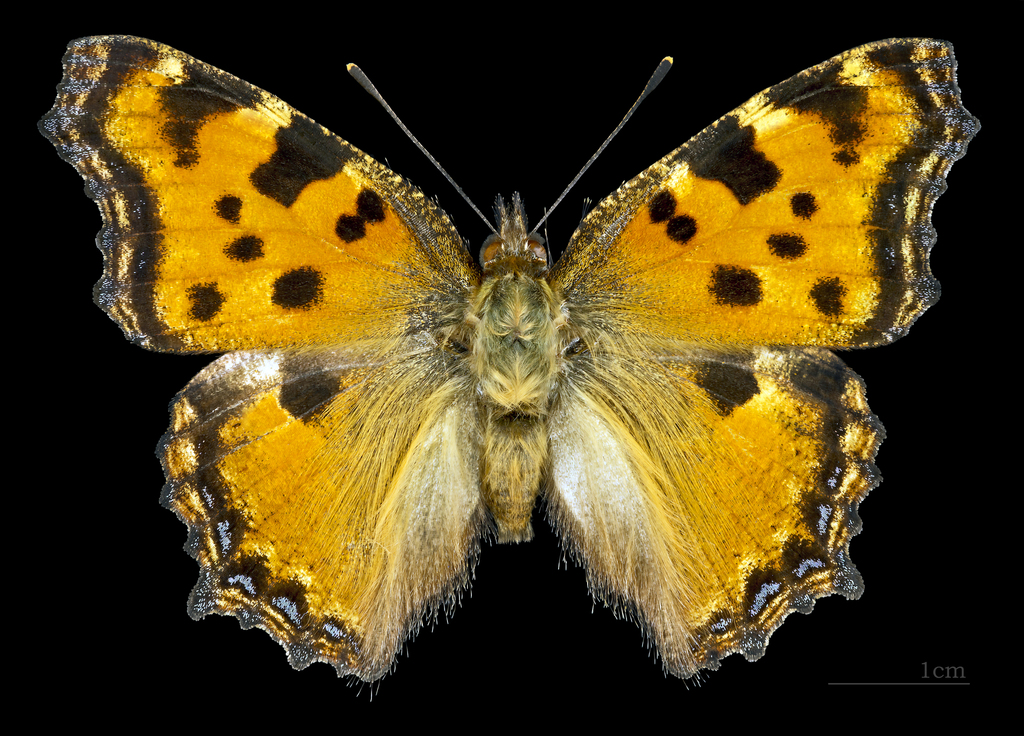
Large tortoiseshell butterflies have a wingspan of about 68 to 75 mm, with females a little larger than males. They live in open woods, edges, clearings, orchards and hedgerows, and have recently returned to Great Britain. Adults feed on tree sap, overripe fruit and honeydew, while the larvae eat leaves of elm, poplar, willow and related trees.
Source: Wikipedia
How to recognize it
The wings are orange-red with black and yellow patches. Both wings have yellowish crescent marks near the edge, a black band of similar marks, and the hindwing shows small blue spots.
Source: Wikipedia
Size
Males have a wingspan of 68 to 72 mm and females 72 to 75 mm.
Source: Wikipedia
Where it lives
They are found in open woodland, woodland edges, clearings, orchards, hedgerows and areas with scattered trees. The species has re-established itself in Great Britain after a long absence.
Source: Wikipedia
What it eats
Caterpillars feed on leaves of various deciduous trees such as elm, poplar and willow. Adult butterflies often drink tree sap, fermenting fruit and honeydew, especially favoring sap and overripe fruit.
Source: Wikipedia
Life cycle
The species has one generation per year; adults emerge in July-August and look for sugary food sources.
Source: Wikipedia
When you see it
Butterflies appear in late February or early March to mate. There is only one generation each year, with adults emerging in July-August.
Source: Wikipedia
More photos

Questions people ask
Are they a problem for gardens or trees?
The caterpillars feed on leaves of many deciduous trees and can cause damage to garden trees and orchard trees.
Source: Wikipedia
When can I expect to see them?
Adults emerge in late winter to early spring to mate and again in midsummer (July-August) for feeding.
Source: Wikipedia
How can I tell them apart from the small tortoiseshell?
They are larger, have a more orange wing colour and orange bases on the hindwings, unlike the smaller, less orange small tortoiseshell.
Source: Wikipedia
Same family (Nymphalidae)






Sources
- Wikipedia: https://en.wikipedia.org/wiki/Large_tortoiseshell
Look it up elsewhere: GBIF · iNaturalist · BugGuide · Wikipedia
Text written 2026-10-22 from the sources above and checked sentence by sentence against them. Data fetched 2026-10-22.