 Bug FAQ
Large Sand Scarab
Pericoptus truncatus · Order: Coleoptera · Family: Scarabaeidae
Also called: Sand scarab

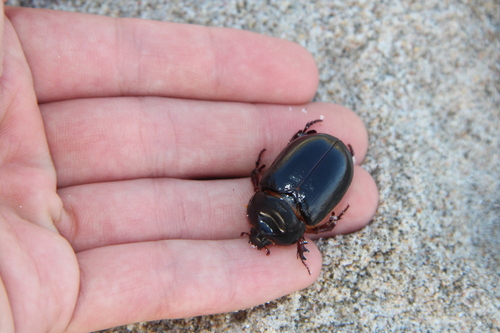
The large sand scarab is a big beetle with a brown-black, slightly shiny body and rust-colored legs and antennae. It lives on New Zealand sandy beaches and dunes, especially where driftwood and marram grass are present, and adults emerge at night to fly and feed.
Source: Wikipedia
How to recognize it
Body is brownish-black and moderately shining; legs and antennae are ferruginous. Head is small and flattened in front of the eyes. Prothorax is much broader than long with rounded angles. Elytra are wider than the thorax and end abruptly.
Source: Wikipedia
Size
It is described as a large sand scarab beetle.
Source: Wikipedia
How to get rid of it
Larvae sometimes immerse themselves in salt-saturated sand at low tide before returning to the dunes.
Source: Wikipedia
Where it lives
Found in sandy shore areas with driftwood, from above the high-tide mark into the dunes.
Source: Wikipedia
What it eats
Larval grubs live under driftwood and feed on the roots of dune plants.
Source: Wikipedia
Life cycle
Females lay eggs deep in the sand; larvae, pupae and adults are found among marram-grass roots and driftwood.
Source: Wikipedia
When you see it
Adults stay buried in sand by day and emerge at night to fly noisily in search of mates and food.
Source: Wikipedia
Where it comes from
It is native to New Zealand.
Source: Wikipedia
Lookalikes
A yellow flower wasp (Radumeris tasmaniensis) can be confused with this beetle in Northland, New Zealand.
Source: Wikipedia
More photos
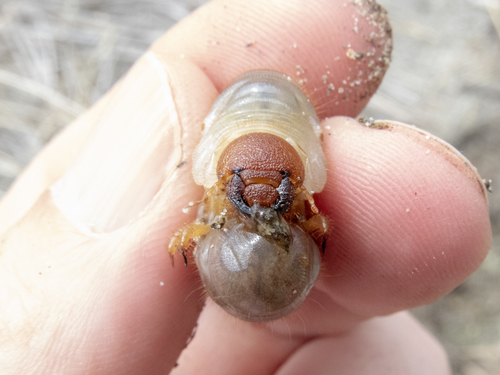
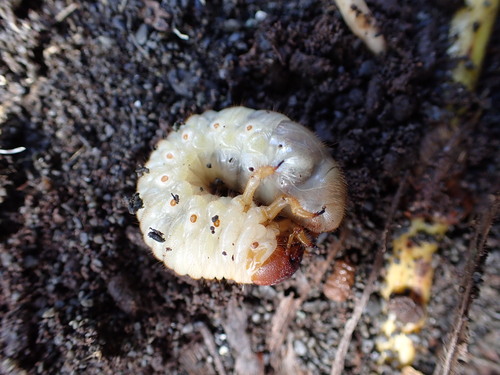
Questions people ask
What does the large sand scarab look like?
It is a big brown-black beetle with a slightly shiny surface, rust-colored legs and antennae, a small flattened head, a broad prothorax with rounded corners, and wide elytra that end abruptly.
Source: Wikipedia
Where can I find this beetle?
It lives on sandy New Zealand beaches and dunes, especially where driftwood and marram grass are present, from above the high-tide line into the dunes.
Source: Wikipedia
What does it eat?
The larvae feed on the roots of dune plants and are often found under driftwood.
Source: Wikipedia
When are the adults active?
Adults stay buried in the sand during daylight and come out at night to fly and look for mates and food.
Source: Wikipedia
Same family (Scarabaeidae)
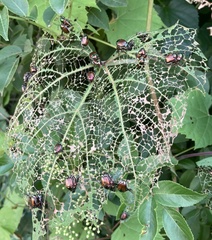 Japanese BeetlePopillia japonicaDamages trees, gardens or crops
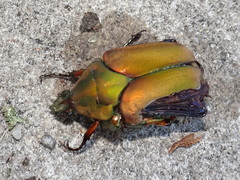 Common Green June BeetleCotinis nitidaDamages trees, gardens or crops
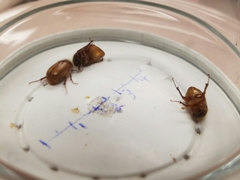 Phyllophaga crinitaPhyllophaga crinitaDamages trees, gardens or crops
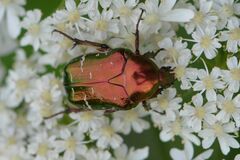 European Rose ChaferCetonia aurata
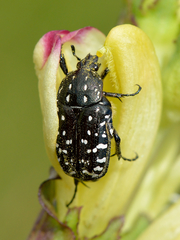 Mediterranean Spotted ChaferOxythyrea funestaDamages trees, gardens or crops
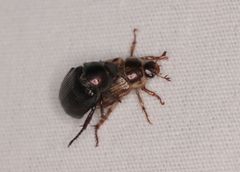 Oriental BeetleExomala orientalisDamages trees, gardens or crops
Sources
- Wikipedia: https://en.wikipedia.org/wiki/Pericoptus_truncatus
Look it up elsewhere: GBIF · iNaturalist · BugGuide · Wikipedia
Text written 2026-10-23 from the sources above and checked sentence by sentence against them. Data fetched 2026-10-23.