 Bug FAQ
Large Pincertail
Onychogomphus uncatus · Order: Odonata · Family: Gomphidae
Also called: Great Pincertail, Blue-eyed Hook-tailed Dragonfly, Blue-eyed Hooktail

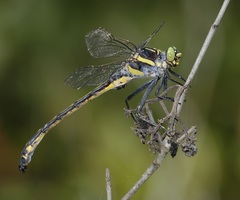
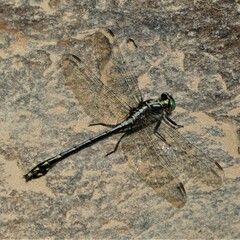
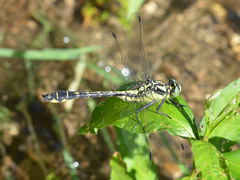
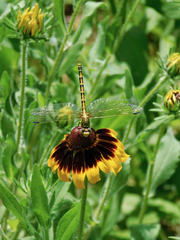
The large pincertail grows up to about 65 mm long and has bright blue or gray-blue eyes that are far apart. It lives near running water and lakes in several European countries and flies from mid-April to late August. Its life cycle lasts roughly three years, and it can be told apart from the similar small pincertail by the shape of black thorax markings and the yellow-only cercoids.
Source: Wikipedia
How to recognize it
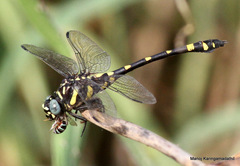
The eyes are widely spaced and never green, showing a bright-blue or gray-blue colour. The rear wing’s anal triangle has four cells and lacks a yellow line on the vertex. All cercoids are yellow.
Source: Wikipedia
Size
Adults can reach up to 65 mm (about 2.6 in) in length.
Source: Wikipedia
Where it lives
They are found near streams, rivers and lakes.
Source: Wikipedia
Life cycle
The species’ life cycle lasts about three years.
Source: Wikipedia
When you see it
Adults are on the wing from mid-April through late August.
Source: Wikipedia
Lookalikes
Differences lie in the shape and extent of black markings on the thorax and the last abdominal segments.
Source: Wikipedia
More photos


Questions people ask
When can I see large pincertail dragonflies?
Adults are active from mid-April to late August.
Source: Wikipedia
Same family (Gomphidae)



![Hectonichus]]](https://commons.wikimedia.org/wiki/File:Gomphidae_-_Onychogomphus_uncatus.JPG)

Sources
- Wikipedia: https://en.wikipedia.org/wiki/Onychogomphus_uncatus
Look it up elsewhere: GBIF · iNaturalist · BugGuide · Wikipedia
Text written 2026-10-23 from the sources above and checked sentence by sentence against them. Data fetched 2026-10-22.