 Bug FAQ
Large-jawed Pedunculate Ground Beetle
Scarites vicinus · Order: Coleoptera · Family: Carabidae
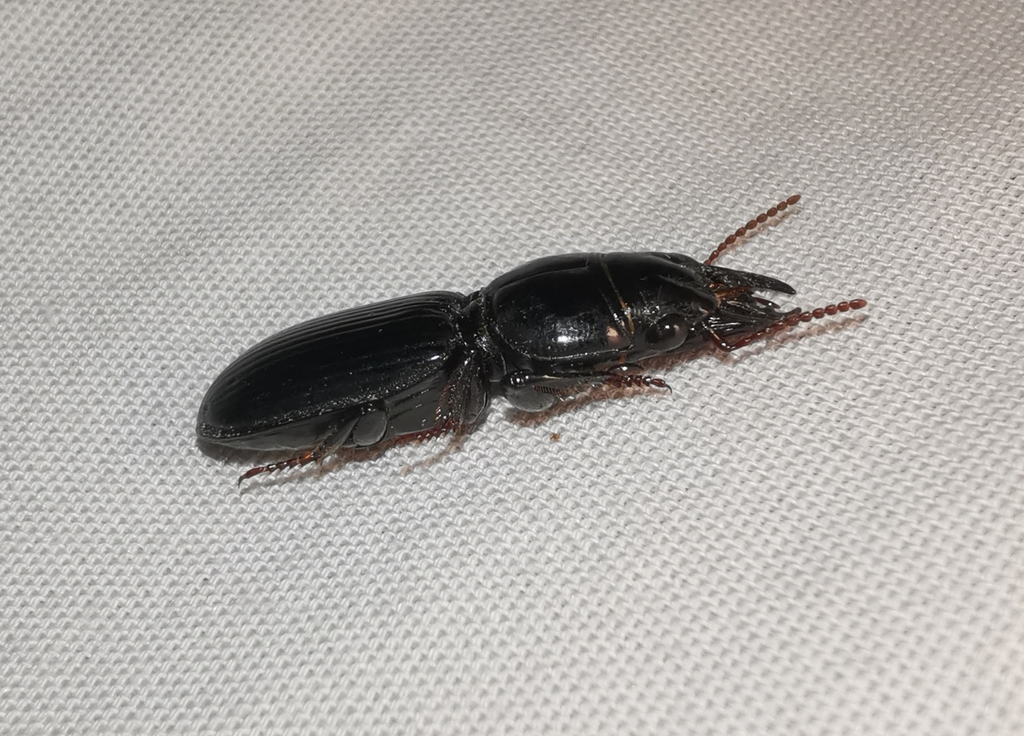
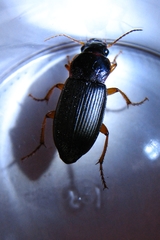
The Large-jawed Pedunculate Ground Beetle is a sleek, black beetle measuring about 14 to 30 mm. Its thorax is round and as wide as its head, which helps tell it apart from other Scarites species. It is found throughout North America.
Source: Wikipedia
How to recognize it
It has a smooth black body and large mandibles.
Source: Wikipedia
Size
Adults are 14 to 30 mm long.
Source: Wikipedia
Where it lives
It occurs in North America.
Source: Wikipedia
Where it comes from
Its native range is North America.
Source: Wikipedia
Lookalikes
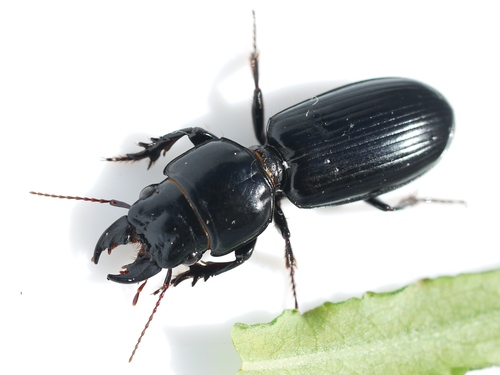
It can be distinguished from other Scarites beetles by its round thorax that is the same width as its head.
Source: Wikipedia
Where it is found in the US
Recorded in 17 of 51 states and DC. Most records: Kansas, Oklahoma, Texas, Alabama, Kentucky, Louisiana, Maryland, Ohio.
Darker = more records. Counts are museum and citizen-science records, not population size.
Source: GBIF
Status: native in North America; native in Canada. Source: iNaturalist
Months it is reported in the US
Source: GBIF
More photos
Questions people ask
How can I identify a Large-jawed Pedunculate Ground Beetle?
Look for a sleek black beetle about 14 to 30 mm long with a round thorax as wide as the head and large mandibles.
Source: Wikipedia
Same family (Carabidae)


Sources
- Wikipedia: https://en.wikipedia.org/wiki/Scarites_vicinus
Look it up elsewhere: GBIF · iNaturalist · BugGuide · ITIS · Wikipedia
Text written 2026-10-27 from the sources above and checked sentence by sentence against them. Data fetched 2026-10-27.