 Bug FAQ
Large Fruit-tree Tortrix
Archips podana · Order: Lepidoptera · Family: Tortricidae
Also called: Large Twist, Tortix moth
Source: Wikipedia
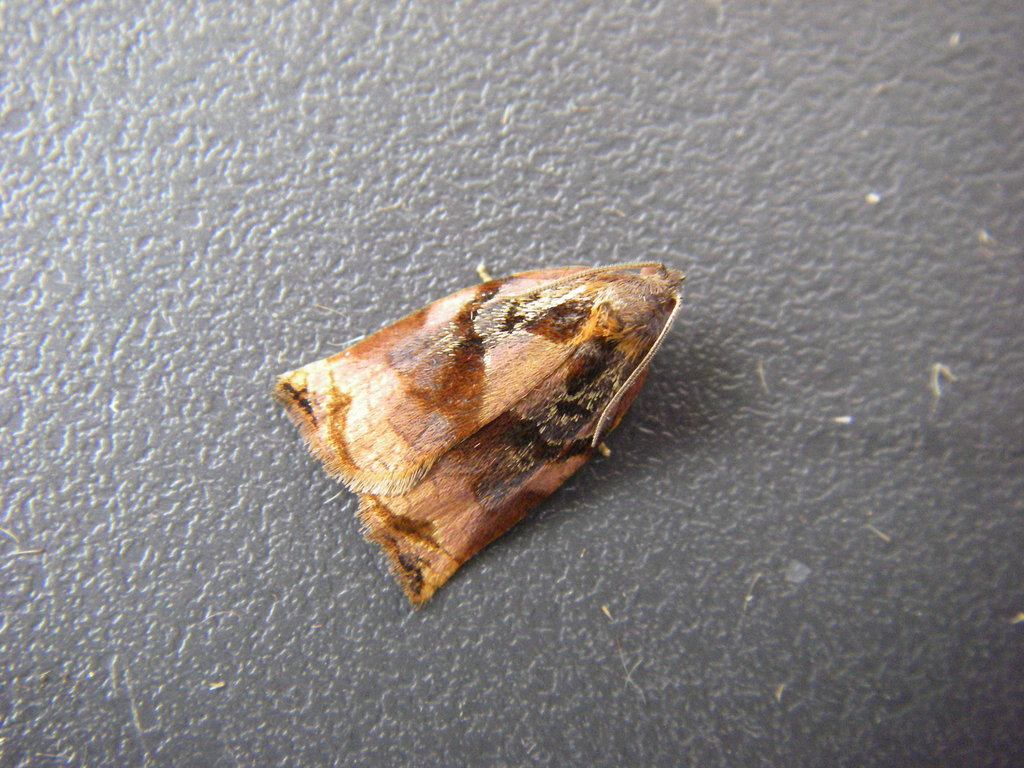
Adults have a wingspan of about 2 cm and show a crested thorax with distinct red-brown markings on the forewings. The moth flies from May to September, laying wax-coated eggs on leaf tops; larvae appear from July through early May and overwinter in silk shelters on twigs.
Source: Wikipedia
How to recognize it
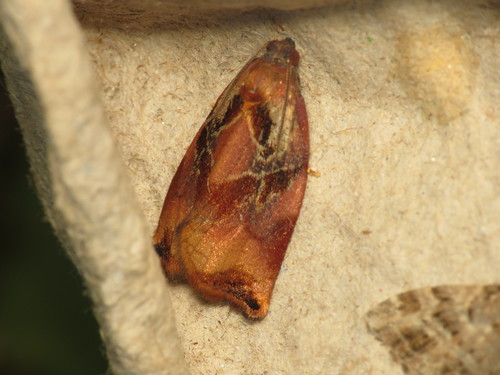
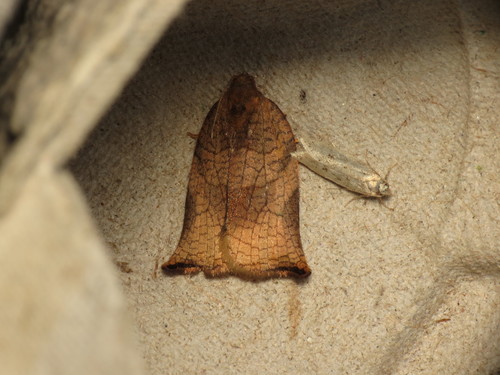
The thorax bears a small crest. Forewings have a wavy vertical edge and a short, reddish-brown costal fold that may show dark brown streaks in females. Males show a dark reddish-brown spot near the wing base with a grey-white shading above it. A central band is dark reddish-brown in males, while females have a lighter brown outline. Additional dark reddish-brown marks appear as a costal patch, an apical spot, and a thickened line from the tornus. Hindwings are grey with a broad orange tip.
Source: Wikipedia
Size
The adult’s wingspan ranges from 18 to 26 mm.
Source: Wikipedia
Where it lives
It occurs across Europe and Asia, from Anatolia to Japan, and has been introduced to North America.
Source: Wikipedia
What it eats
Larvae are polyphagous, feeding on leaves of apple, pear, cherry, plum and occasionally conifers. They initially eat both leaf surfaces, then spin a fine web and continue feeding on the underside.
Source: Wikipedia
Life cycle
Adults are on the wing in one generation from May through September in western Europe. Females lay several batches of 50 to 100 eggs on leaf tops, covering them with a waxy coating that matches leaf colour. Eggs hatch after about three weeks and larvae are present from July to early May. Larvae feed until fruit is harvested, then build a silk hibernaculum on a twig to overwinter. In spring, fourth-instar larvae bore into opening buds and later feed between spun leaves. Pupation occurs within the larval shelter.
Source: Wikipedia
When you see it
The moth flies from May to September, mainly in the late afternoon and is attracted to light.
Source: Wikipedia
Where it comes from
Its native range covers Europe and Asia, extending from Anatolia to Japan.
Source: Wikipedia
Where it is found in the US
Recorded in 1 of 51 states and DC. Most records: Washington.
Darker = more records. Counts are museum and citizen-science records, not population size.
Source: GBIF
Status: introduced in Canada. Source: iNaturalist
More photos
Questions people ask
How can I recognise the Large Fruit-tree Tortrix moth?
Look for a 2 cm wingspan, a crested thorax, grey hindwings with an orange tip, and distinctive dark reddish-brown marks on the forewings.
Source: Wikipedia
When are these moths active?
Adults are active from May through September, flying in the late afternoon and coming to lights.
Source: Wikipedia
What plants do the larvae damage?
The caterpillars feed on the leaves and buds of apple, pear, cherry, plum and sometimes conifer trees, which can harm fruit production.
Source: Wikipedia
Where is this species found?
It is native to Europe and Asia from Anatolia to Japan and has been introduced to North America.
Source: Wikipedia
Same family (Tortricidae)
 Oblique-banded Leafroller MothChoristoneura rosaceanaDamages trees, gardens or crops
 Garden TortrixClepsis peritanaDamages trees, gardens or crops
 Common MarbleSyricoris lacunanaDamages trees, gardens or crops
 Red-banded Leafroller MothArgyrotaenia velutinanaDamages trees, gardens or crops
 Light Brown Apple MothEpiphyas postvittanaDamages trees, gardens or crops
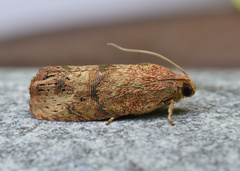 Filbertworm MothCydia latiferreanaDamages trees, gardens or crops
Sources
- Wikipedia: https://en.wikipedia.org/wiki/Archips_podana
Look it up elsewhere: GBIF · iNaturalist · BugGuide · Wikipedia
Text written 2026-10-22 from the sources above and checked sentence by sentence against them. Data fetched 2026-10-22.