 Bug FAQ
Common Marble
Syricoris lacunana · Order: Lepidoptera · Family: Tortricidae
Also called: dark strawberry tortrix
Source: Wikipedia
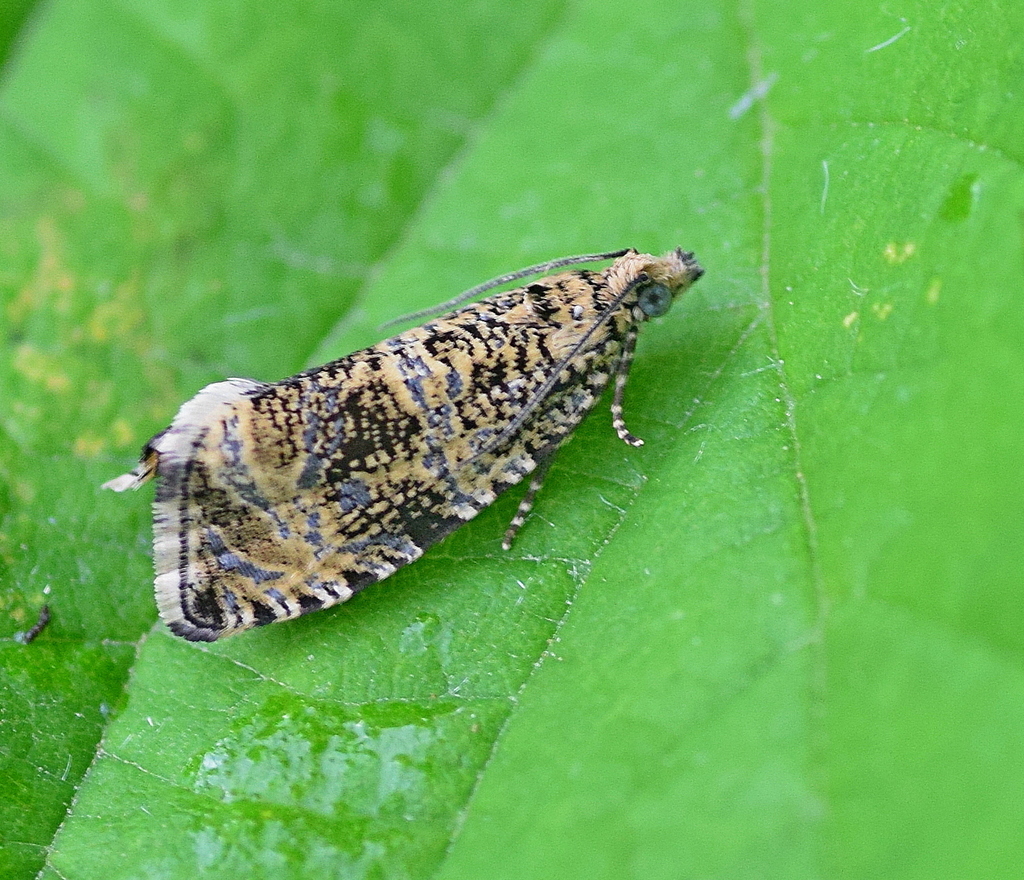
Adults have a wingspan of about 16 to 18 mm and show gray-brown forewings crossed by thin silvery lines. Caterpillars grow to roughly 15 mm, are brown to dark brown, and feed on many herbaceous plants and young trees. They are common in hedgerows, fields and woodland edges across Europe and the Palearctic, flying from late April to September.
Source: Wikipedia
How to recognize it
The forewings are gray-brown with a few thin, irregular silvery lines.
Source: Wikipedia
Size
Wingspan ranges from 16 to 18 mm. Caterpillars reach about 15 mm in length.
Source: Wikipedia
Where it lives
Found in hedgerows, fields and at the edges of woodlands.
Source: Wikipedia
What it eats
Larvae are polyphagous, feeding on many herbaceous plants such as carrot, mint, ragwort, strawberry and on young shoots of trees like willow, birch, larch and spruce.
Source: Wikipedia
Life cycle
It has one generation per year (univoltine).
Source: Wikipedia
When you see it
Adults are active at dusk from late April through September in temperate areas.
Source: Wikipedia
Where it comes from
Occurs throughout the Palearctic, including most of Europe and the Near East.
Source: Wikipedia
Lookalikes
Can be confused with Olethreutes obsoletana, Celypha doubledayana, and Orthotaenia undulana.
Source: Wikipedia
Where it is found in the US
Recorded in 2 of 51 states and DC. Most records: Oregon, Alaska.
Darker = more records. Counts are museum and citizen-science records, not population size.
Source: GBIF
Status: native in North America; native in Canada. Source: iNaturalist
More photos

Questions people ask
Are they a problem for my garden?
The caterpillars can feed on many garden plants and may cause damage to leaves and young shoots.
Source: Wikipedia
When will I see them?
Adults appear from late April to September, usually flying at dusk.
Source: Wikipedia
How can I tell this moth apart from similar species?
Look for gray-brown forewings with thin silvery lines; however, it can resemble Olethreutes obsoletana, Celypha doubledayana, or Orthotaenia undulana.
Source: Wikipedia
Same family (Tortricidae)
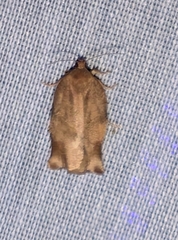 Oblique-banded Leafroller MothChoristoneura rosaceanaDamages trees, gardens or crops
 Garden TortrixClepsis peritanaDamages trees, gardens or crops
 Red-banded Leafroller MothArgyrotaenia velutinanaDamages trees, gardens or crops
 Light Brown Apple MothEpiphyas postvittanaDamages trees, gardens or crops
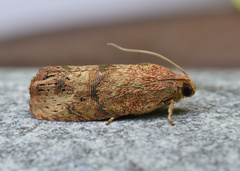 Filbertworm MothCydia latiferreanaDamages trees, gardens or crops
 Codling MothCydia pomonellaDamages trees, gardens or crops
Sources
- Wikipedia: https://en.wikipedia.org/wiki/Syricoris_lacunana
Look it up elsewhere: GBIF · iNaturalist · BugGuide · Wikipedia
Text written 2026-10-22 from the sources above and checked sentence by sentence against them. Data fetched 2026-10-22.