 Bug FAQ
Large Black Kekerengu
Platyzosteria novaeseelandiae · Order: Blattodea · Family: Blattidae
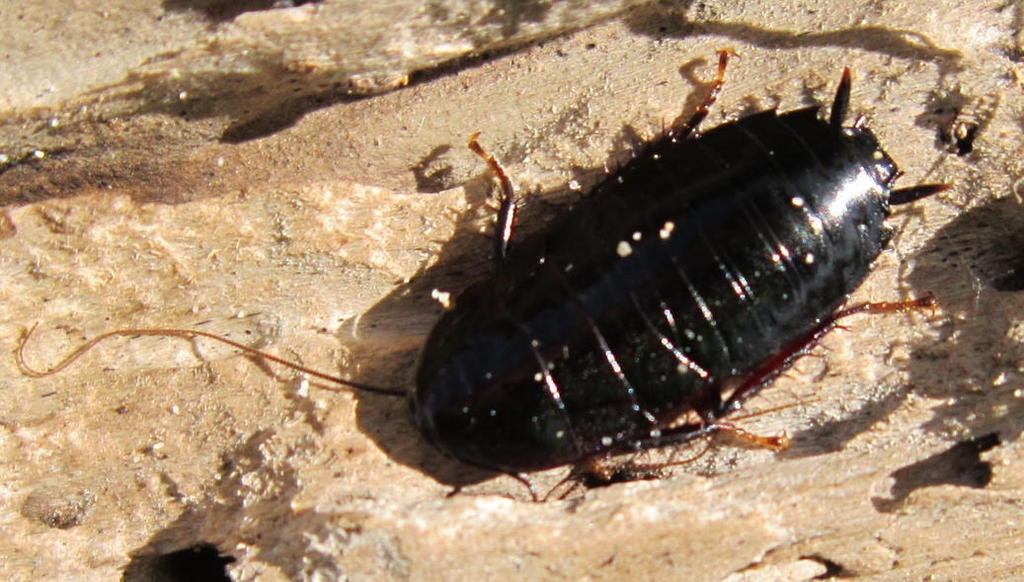
The Large Black Kekerengu is a big cockroach about 2.5 to 2.9 cm long. It lives in lowland forests and coastal areas of New Zealand, hiding under logs, stones, bark and leaf litter, and feeds on decaying plant material. Adults have dark-red legs and antennae that start brown at the base and become lighter toward the tips.
Source: Wikipedia
How to recognize it
Legs are dark red and the antennae are brown at the base, fading to a lighter colour near the ends.
Source: Wikipedia
Size
Adults measure between 25 and 29 mm in length.
Source: Wikipedia
Where it lives
It is nocturnal, spending daylight hidden under bark, stones or logs and emerges at night.
Source: Wikipedia
What it eats
It feeds on decaying plant material.
Source: Wikipedia
Life cycle
Only adult cockroaches produce the defensive chemical from the gland.
Source: Wikipedia
Where it comes from
The species is native to lowland forests throughout New Zealand’s North Island and coastal parts of the northern South Island.
Source: Wikipedia
Lookalikes
A similar black cockroach from Australia lacks adult tegmina, which helps tell them apart.
Source: Wikipedia
Questions people ask
Where is this cockroach found?
It lives in lowland forests and coastal areas of New Zealand’s North Island and northern South Island.
Source: Wikipedia
How can I tell it apart from similar black cockroaches?
It has dark-red legs and antennae that are brown at the base and lighten toward the tips, and adults have tegmina, unlike the Australian look-alike.
Source: Wikipedia
Same family (Blattidae)
 American CockroachPeriplaneta americanaCan spread germs or disease
 Oriental CockroachBlatta orientalisCan spread germs or disease
 Smokybrown CockroachPeriplaneta fuliginosaNuisance, not dangerous
 Australian CockroachPeriplaneta australasiaeNuisance, not dangerous
 Turkestan CockroachPeriplaneta lateralis
 Florida Woods CockroachEurycotis floridana
Sources
- Wikipedia: https://en.wikipedia.org/wiki/Platyzosteria_novaeseelandiae
Look it up elsewhere: GBIF · iNaturalist · BugGuide · Wikipedia
Text written 2026-10-23 from the sources above and checked sentence by sentence against them. Data fetched 2026-10-23.