 Bug FAQ
Oriental Cockroach
Blatta orientalis · Order: Blattodea · Family: Blattidae
Also called: Asian Cockroach, Asiatic Cockroach, Common Cockroach, Shad Cockroach

These cockroaches are large, dark, and glossy insects that like damp places such as basements, drains, and mulch. They carry disease-causing germs on their legs and can contaminate food, utensils, and countertops, posing a health risk.
Source: Wikipedia, Utah State Extension
How to recognize it
Females may look wingless at a glance because their wings are tiny and sit just under the head.
Source: Wikipedia
Size
Males are 18 to 29 mm long and females 20 to 27 mm. Some sources note they are about 10 to 12 mm long.
Source: Wikipedia
Is it a pest in the house?
They can become major pests in homes, especially basements, crawl spaces, and near drains or leaky pipes. Infestations are common in apartments, restaurants, hospitals, warehouses, and other food-handling areas. They contaminate food, kitchen utensils, and surfaces, produce bad odors, and can stain or damage fabrics and paper. Their presence is linked to increased allergens and asthma risk, especially for children in multi-unit housing.
Source: Wikipedia, Utah State Extension, UC IPM, University of Minnesota Extension, entomology.ca.uky.edu
Does it bite or sting?
Their saliva, feces, and shed skins can trigger allergic reactions and asthma in sensitive people.
Source: Utah State Extension, University of Minnesota Extension
How to get rid of it
They thrive in warm, humid conditions; optimal temperature is 20 to 29 °C. Look for egg cases (oothecae) as a sign of infestation. Use cockroach baits or boric acid dust to reduce populations. Repair leaks and fix plumbing problems to eliminate moisture sources. Maintain good sanitation and exclude entry points; pesticides alone are insufficient. Place insecticide gels or bait stations near hiding spots after removing food and water sources. Professional pest-management services can apply appropriate pesticides for larger problems.
Source: Wikipedia, Utah State Extension, UC IPM, University of Minnesota Extension
Where it lives
They prefer dark, moist locations such as decaying organic matter, leaf litter, mulch, sewer pipes, drains, basements, and other damp areas around homes.
Source: Wikipedia
What it eats
They need a source of food or liquid and a hiding place to survive.
Source: Wikipedia
Life cycle
After mating, females produce blackish-brown egg cases (oothecae) that are deposited within a few days in a protected spot.
Source: Wikipedia
When you see it
They are mainly nocturnal and may be hard to notice during daytime inspections.
Source: Wikipedia
Where it comes from
Originally from the Crimean Peninsula and the Black-Sea/Caspian-Sea region, they are now found worldwide.
Source: Wikipedia
Lookalikes
Female Oriental cockroaches can be confused with Florida woods cockroaches. Immature nymphs lack wings, which can make them look like other small cockroach species. Unlike beetles, adult cockroaches have membranous wings and no hardened forewings.
Where it is found in the US
Recorded in 42 of 51 states and DC. Most records: California, Illinois, Virginia, Maryland, Utah, Pennsylvania, District of Columbia, Missouri.
Darker = more records. Counts are museum and citizen-science records, not population size.
Source: GBIF
Status: introduced in North America; introduced in Canada; introduced in United States. Source: iNaturalist
Months it is reported in the US
Source: GBIF
More photos


Questions people ask
How can I tell if I have Oriental cockroaches?
Look for large, shiny black or dark-brown insects about 1 inch long; males have half-length wings, females have very short wings, and they are often found in damp areas like basements and drains.
Source: Wikipedia, Utah State Extension, entomology.ca.uky.edu
What should I do to get rid of them?
Fix any leaks, keep areas dry and clean, use baits or boric acid, and consider professional pest control if the infestation is heavy.
Source: Wikipedia, Utah State Extension, University of Minnesota Extension
Same family (Blattidae)
 American CockroachPeriplaneta americanaCan spread germs or disease
 Smokybrown CockroachPeriplaneta fuliginosaNuisance, not dangerous
 Australian CockroachPeriplaneta australasiaeNuisance, not dangerous
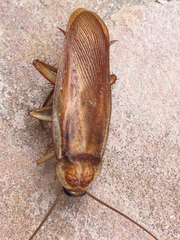 Turkestan CockroachPeriplaneta lateralis
 Florida Woods CockroachEurycotis floridana
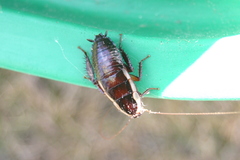 Gisborne CockroachDrymaplaneta semivittaHarmless
Sources
- Wikipedia: https://en.wikipedia.org/wiki/Oriental_cockroach
- UC IPM: https://ipm.ucanr.edu/PMG/PESTNOTES/pn7467.html
- Utah State Extension: https://extension.usu.edu/pests/ipm/notes_nuisance/oriental-cockroach
- University of Minnesota Extension: https://extension.umn.edu/insects-infest-homes/cockroaches
- entomology.ca.uky.edu: https://entomology.ca.uky.edu/ef614
Look it up elsewhere: GBIF · iNaturalist · BugGuide · ITIS · Wikipedia
Text written 2026-10-22 from the sources above and checked sentence by sentence against them. Data fetched 2026-10-22.