 Bug FAQ
Australian Cockroach
Periplaneta australasiae · Order: Blattodea · Family: Blattidae

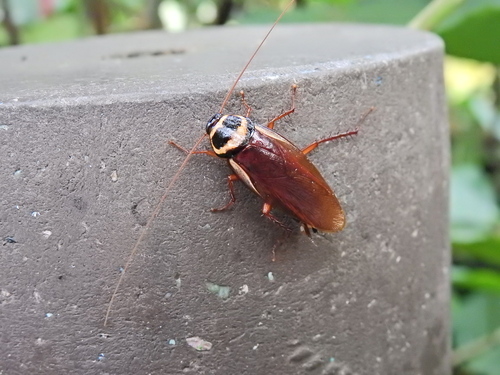
Adults are 23 to 35 mm long, brown with a pale stripe on the fore-wings and a yellow margin on the pronotum. They prefer warm, tropical climates, live around building edges, and may wander indoors for food.
How to recognize it
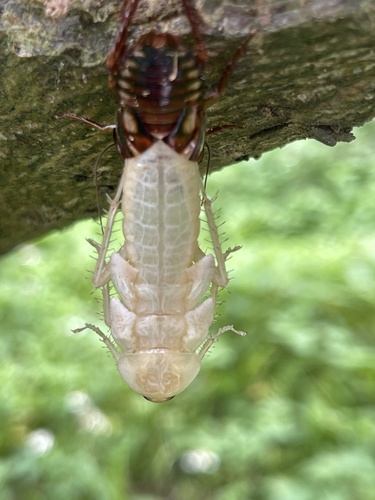
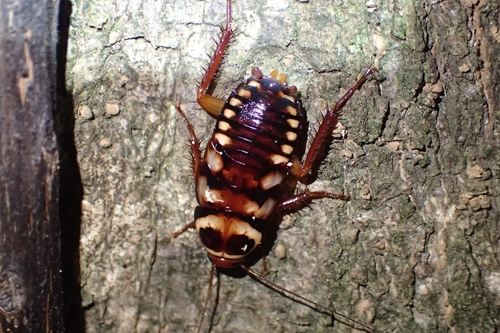
They are brown overall with a noticeable pale stripe on the fore-wings and a contrasting pale or yellow edge on the pronotum. They look a lot like American cockroaches but are a bit smaller and have yellow margins on the thorax and side streaks near the wing base.
Size
Adults measure 23 to 35 mm (0.9 to 1.4 in) in length.
Source: Wikipedia
Is it a pest in the house?
They may come inside looking for food and can become indoor pests, especially in warm weather. Outdoor species that get inside are considered serious nuisance pests and potential public-health concerns.
How to get rid of it
Good sanitation and sealing entry points are key; pesticides alone rarely solve the problem. For serious infestations, call a licensed pest-control professional.
Source: UC IPM
Where it lives
They favor warm, tropical areas and are not tolerant of cold, though they can survive indoors in cooler regions. They are often found around the outer walls of buildings.
Source: Wikipedia
What it eats
They mainly eat plant material but will also scavenge a wide range of organic matter, including decaying material.
Source: Wikipedia
Where it comes from
The species likely originated in Africa and now occurs in tropical parts of Australia, from Cape York down to the Victorian border.
Source: Wikipedia
Lookalikes
They are often mistaken for American cockroaches. Unlike beetles, adult cockroaches have membranous wings and lack hard forewings. Termites are close relatives within the same superorder Dictyoptera.
Where it is found in the US
Recorded in 16 of 51 states and DC. Most records: Florida, Virginia, Hawaii, Michigan, Texas, Utah, South Carolina, California.
Darker = more records. Counts are museum and citizen-science records, not population size.
Source: GBIF
Months it is reported in the US
Source: GBIF
More photos
Questions people ask
How can I tell an Australian cockroach apart from an American cockroach?
Look for a pale stripe on the fore-wings and a yellow edge on the pronotum; they are also a bit smaller than American cockroaches.
What should I do if I have an Australian cockroach problem at home?
Keep the area clean, remove food sources, and seal cracks; if the problem persists, contact a licensed pest-control professional.
Source: UC IPM
Same family (Blattidae)
 American CockroachPeriplaneta americanaCan spread germs or disease
 Oriental CockroachBlatta orientalisCan spread germs or disease
 Smokybrown CockroachPeriplaneta fuliginosaNuisance, not dangerous
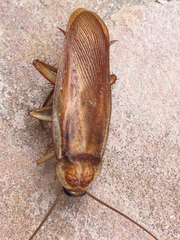 Turkestan CockroachPeriplaneta lateralis
 Florida Woods CockroachEurycotis floridana
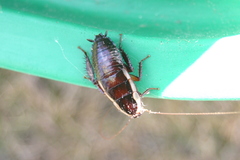 Gisborne CockroachDrymaplaneta semivittaHarmless
Sources
- Wikipedia: https://en.wikipedia.org/wiki/Australian_cockroach
- UC IPM: https://ipm.ucanr.edu/PMG/PESTNOTES/pn7467.html
Look it up elsewhere: GBIF · iNaturalist · BugGuide · ITIS · Wikipedia
Text written 2026-10-23 from the sources above and checked sentence by sentence against them. Data fetched 2026-10-22.