 Bug FAQ
Large Beech Piercer
Cydia fagiglandana · Order: Lepidoptera · Family: Tortricidae
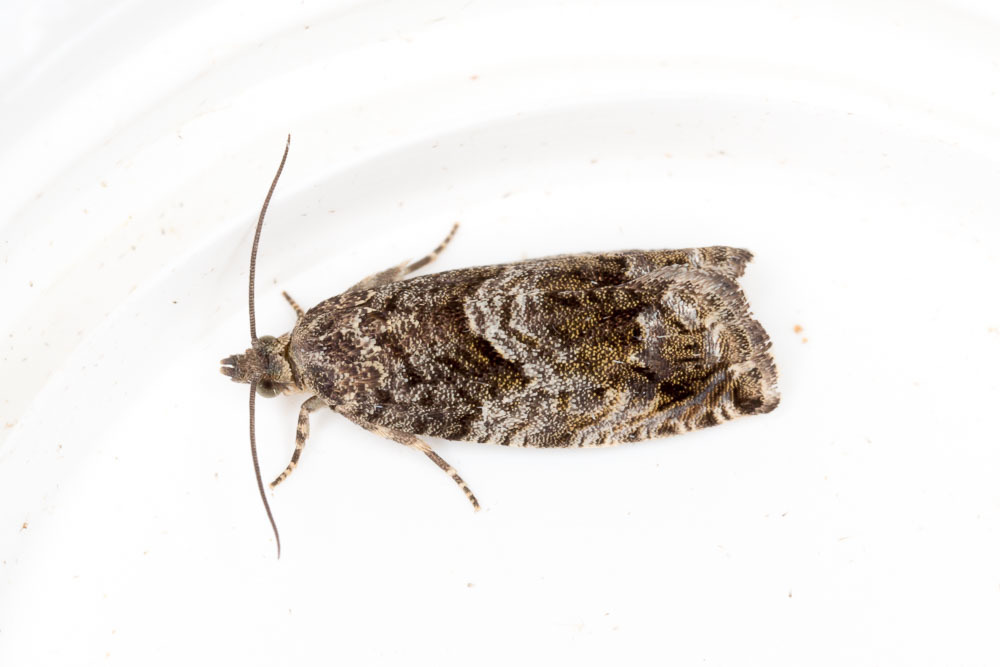
The Large Beech Piercer is a small moth with a wingspan of about 12 to 16 mm and brown-black forewings speckled with white and crossed by fine dark stripes; its hindwings are dark brownish-gray. It lives in beech woodlands across most of Europe, where its larvae feed mainly on beech nuts and sometimes on oak, taking up to two years to develop before pupating in soil or rotting wood. Adults fly from April to September, are active in the evenings, and look similar to Cydia splendana.
Source: Wikipedia
How to recognize it
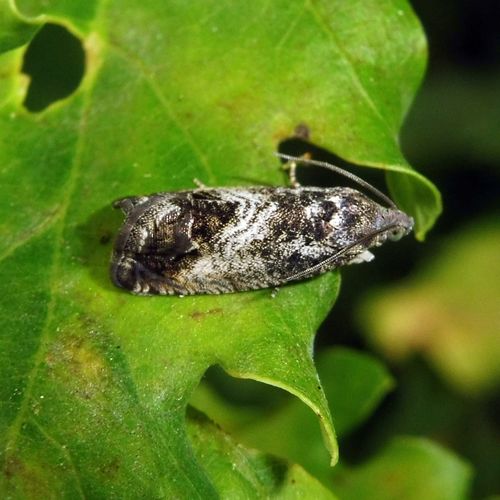
The forewings are brown-black with whitish speckles and two fine dark brown stripes, while the hindwings are uniformly dark gray.
Source: Wikipedia
Size
Its wingspan ranges from 12 to 16 mm.
Source: Wikipedia
Where it lives
It is found mainly in beech woodlands because its larvae rely on beech seeds.
Source: Wikipedia
What it eats
Larvae usually eat beech nuts but will also feed on oak species such as Quercus ilex and Quercus robur.
Source: Wikipedia
Life cycle
The larval stage can last two years, after which pupation takes place in a cocoon in soil or decaying wood.
Source: Wikipedia
When you see it
Adults are on the wing from April through September, depending on location, and are active in the evening.
Source: Wikipedia
Where it comes from
The species occurs throughout most of Europe.
Source: Wikipedia
Lookalikes
It resembles the moth Cydia splendana.
Source: Wikipedia
More photos
Questions people ask
When can I see the Large Beech Piercer?
Adults fly from April to September, with the exact timing varying by location, and they are most active in the evenings.
Source: Wikipedia
Where does this moth live?
It lives in beech woodlands across most of Europe, where its larvae depend on beech seeds.
Source: Wikipedia
How can I tell it apart from similar moths?
Look for brown-black forewings with whitish speckles and two fine dark stripes; the hindwings are uniformly dark gray, and it is similar to Cydia splendana.
Source: Wikipedia
Same family (Tortricidae)
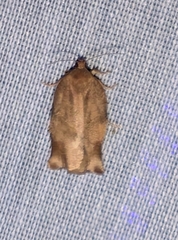 Oblique-banded Leafroller MothChoristoneura rosaceanaDamages trees, gardens or crops
 Garden TortrixClepsis peritanaDamages trees, gardens or crops
 Common MarbleSyricoris lacunanaDamages trees, gardens or crops
 Red-banded Leafroller MothArgyrotaenia velutinanaDamages trees, gardens or crops
 Light Brown Apple MothEpiphyas postvittanaDamages trees, gardens or crops
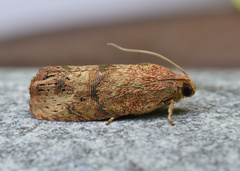 Filbertworm MothCydia latiferreanaDamages trees, gardens or crops
Sources
- Wikipedia: https://en.wikipedia.org/wiki/Cydia_fagiglandana
Look it up elsewhere: GBIF · iNaturalist · BugGuide · Wikipedia
Text written 2026-10-23 from the sources above and checked sentence by sentence against them. Data fetched 2026-10-22.