 Bug FAQ
Scarab beetle (Labarrus lividus)
Labarrus lividus · Order: Coleoptera · Family: Scarabaeidae
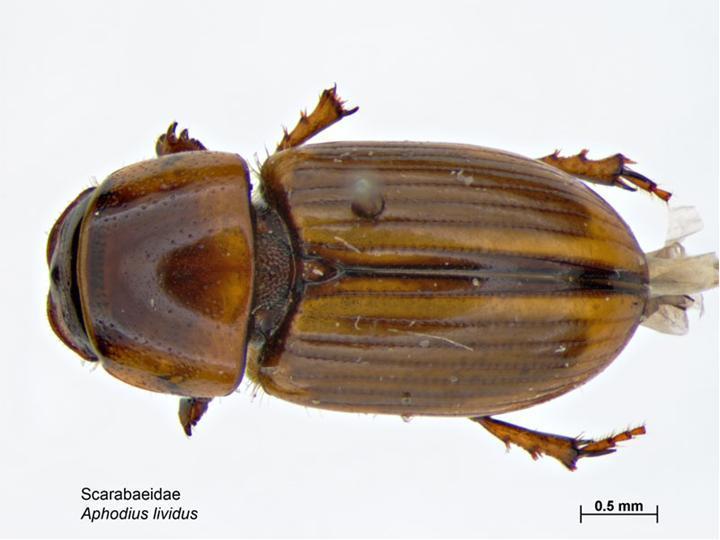
Adults are tiny, measuring about 3 to 4.5 mm long. The head’s clypeus is clearly notched and has a rough, punctured surface, while the pronotum is strongly rounded with two sizes of punctures, the larger ones being few. It is native to many regions across the Palaearctic, Afrotropical, Nearctic, Neotropical, Australian and Oriental zones, including the United States (Colorado, Illinois, Indiana, Iowa, Kansas, Maryland, Texas).
Source: Wikipedia
How to recognize it
The clypeus is clearly notched and has a rugose, punctured front surface. The pronotum is strongly convex with two sizes of punctures, the larger ones being scarce.
Source: Wikipedia
Where it comes from
In North America it occurs in the United States, specifically Colorado, Illinois, Indiana, Iowa, Kansas, Maryland and Texas. It is also native to many Palaearctic countries such as France, Germany, Russia and Turkey, as well as to African nations like Egypt and Kenya, to Central and South American regions, to Australia and Papua New Guinea, and to parts of South-Asia.
Source: Wikipedia
Where it is found in the US
Recorded in 27 of 51 states and DC. Most records: Texas, California, Arizona, Indiana, Kansas, Oklahoma, Mississippi, New Mexico.
Darker = more records. Counts are museum and citizen-science records, not population size.
Source: GBIF
Months it is reported in the US
Source: GBIF
More photos
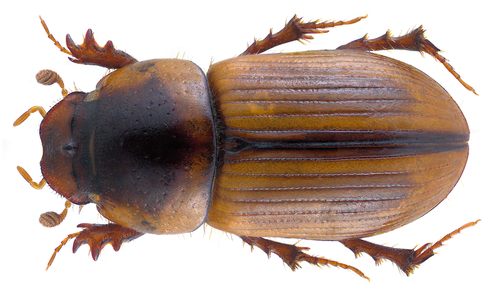

Same family (Scarabaeidae)
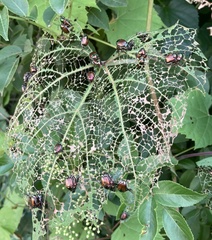 Japanese BeetlePopillia japonicaDamages trees, gardens or crops
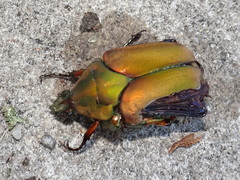 Common Green June BeetleCotinis nitidaDamages trees, gardens or crops
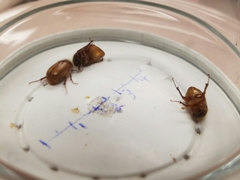 Phyllophaga crinitaDamages trees, gardens or crops
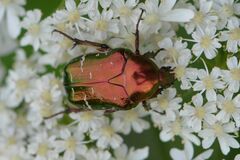 European Rose ChaferCetonia aurata
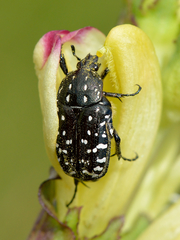 Mediterranean Spotted ChaferOxythyrea funestaDamages trees, gardens or crops
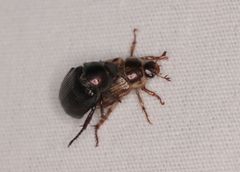 Oriental BeetleExomala orientalisDamages trees, gardens or crops
Sources
- Wikipedia: https://en.wikipedia.org/wiki/Labarrus_lividus
Look it up elsewhere: GBIF · iNaturalist · BugGuide · ITIS · Wikipedia
Text written 2026-10-25 from the sources above and checked sentence by sentence against them. Data fetched 2026-10-25.