 Bug FAQ
July Comet
Photuris lucicrescens · Order: Coleoptera · Family: Lampyridae
Also called: Big Scary
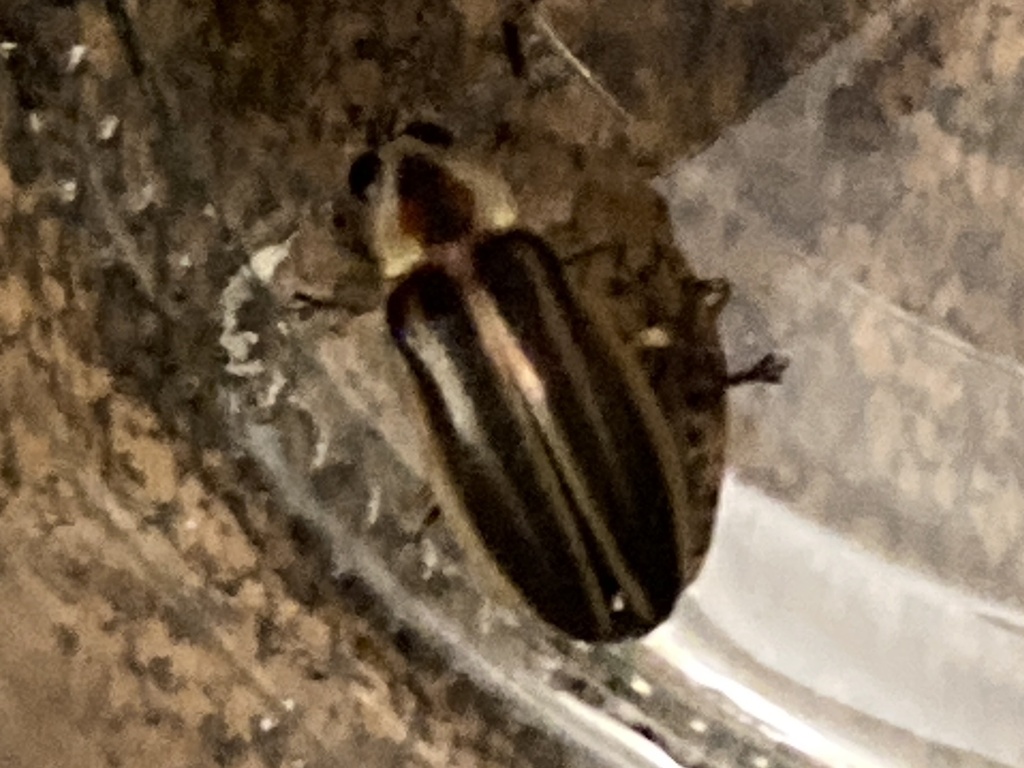
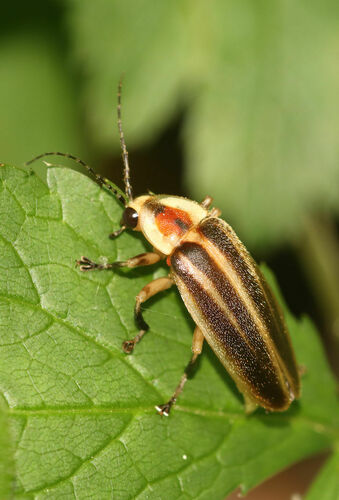
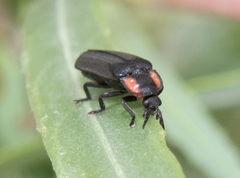
July Comet fireflies are large, 15 to 20 mm long, with brown wing covers that have light-colored side margins and a central stripe, and a yellow pronotum marked by a dark arrow often appearing as two spots. They live in moist forested floodplains for breeding, while females also occupy open fields, woods, and a range of moisture conditions from valleys to mountains across the eastern United States and southern Canada. Larvae prey on snails, worms and other soft-bodied invertebrates, and adult females use aggressive mimicry to lure and eat other fireflies; adults emerge in mid-summer (June-August) with flashing patterns that start as a crescendo in June and become more varied in July.
Source: Wikipedia
How to recognize it
The wing covers are brown with wide light-colored side margins and a central stripe that runs from the shoulder almost the full body length. The pronotum is yellow and bears a dark arrow in the centre that is often broken into two marks.
Source: Wikipedia
Where it lives
They are mainly associated with moist, forested floodplain habitats, which serve as their primary breeding ground. Females also occupy open fields and wooded areas, tolerating conditions from dry to moderately moist and ranging from valleys to mountainous regions.
Source: Wikipedia
What it eats
Larvae are predatory, feeding on snails, worms and other soft-bodied invertebrates. Adult females practice aggressive mimicry, flashing to lure other firefly species and then eating them.
Source: Wikipedia
Life cycle
They develop through four stages: egg, larva, pupa, and adult.
Source: Wikipedia
When you see it
Adults are present from June through August. Typical flashing crescendos occur earlier in June, shifting to more varied patterns in July.
Source: Wikipedia
Lookalikes
A female will answer a flash from low vegetation.
Source: Wikipedia
Where it is found in the US
Recorded in 8 of 51 states and DC. Most records: Virginia, Maryland, North Carolina, Pennsylvania, Kentucky, Delaware, Indiana, Arkansas.
Darker = more records. Counts are museum and citizen-science records, not population size.
Source: GBIF
Months it is reported in the US
Source: GBIF
More photos
Questions people ask
When do July Comet fireflies appear?
Adults emerge in mid-summer, typically from June to August.
Source: Wikipedia
What do they look like?
They are large fireflies with brown wing covers that have light margins and a central stripe, and a yellow pronotum marked by a dark arrow often split into two spots.
Source: Wikipedia
Where are they found?
They live in the eastern United States and southern Canada, especially in moist forested floodplains, but females also occupy open fields and wooded areas across a range of elevations.
Source: Wikipedia
What do the larvae eat?
Larvae prey on snails, worms and other soft-bodied invertebrates.
Source: Wikipedia
Same family (Lampyridae)


Sources
- Wikipedia: https://en.wikipedia.org/wiki/Photuris_lucicrescens
Look it up elsewhere: GBIF · iNaturalist · BugGuide · ITIS · Wikipedia
Text written 2026-10-29 from the sources above and checked sentence by sentence against them. Data fetched 2026-10-29.