 Bug FAQ
Winter Firefly
Photinus corruscus · Order: Coleoptera · Family: Lampyridae
Source: Wikipedia

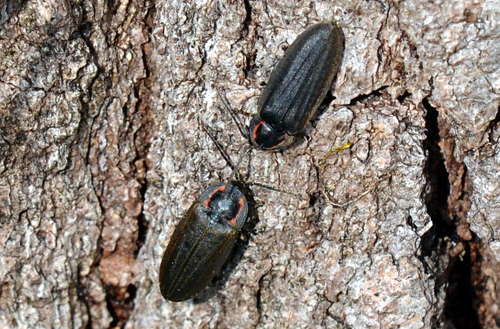
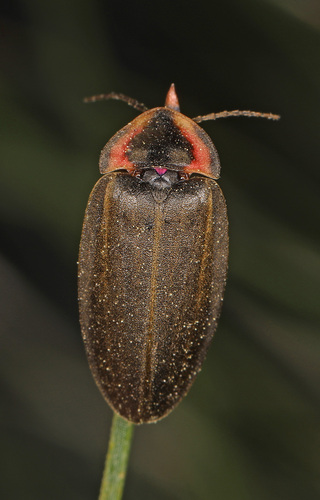
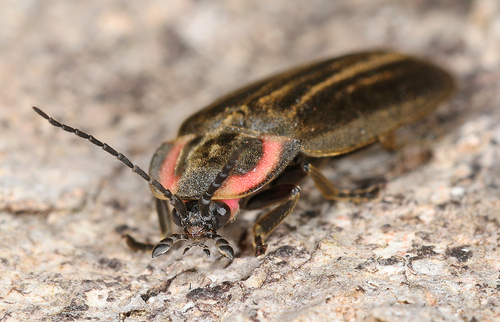
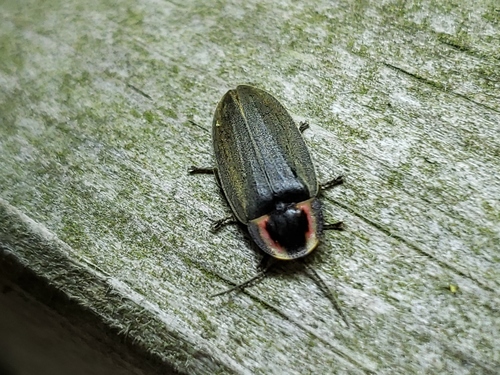
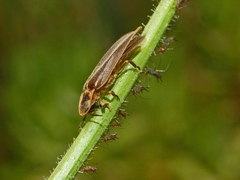
Winter fireflies are medium to large beetles about 9-18 mm long with a distinctive black mark on the pronotum surrounded by yellow and pink, and dark elytra that may look greenish or golden in the light. They live in hardwood forests, yards and parks, especially where maple trees are present, and the larvae develop in decaying wood for over a year before emerging as adults. Adults feed on nectar from Norway maple flowers and are attracted to natural sap flows, often ending up in maple syrup collection buckets where they can become a significant pest.
Source: Wikipedia
How to recognize it
The pronotum has a rounded black spot bordered by yellow and pink on each side. The wing covers are dark and have fine hairs that may appear greenish or golden in certain light.
Source: Wikipedia
Size
Adults measure between 9 and 18 mm in length.
Source: Wikipedia
Is it a pest in the house?
Their attraction to maple sap can lead to large numbers in sap buckets, creating economic concerns for syrup producers.
Source: Wikipedia
Where it lives
Commonly encountered in maple sap collection buckets used in the syrup industry.
Source: Wikipedia
What it eats
Adults feed on nectar from Norway maple flowers. They are also attracted to natural sap flows of sugar maple.
Source: Wikipedia
Life cycle
Females lay eggs near suitable sites; eggs hatch in early summer.
Source: Wikipedia
When you see it
Adults overwinter for one year and are not seen flying from late fall through winter.
Source: Wikipedia
Where it comes from
Occurs throughout the United States, Canada east of the Rockies, and Mexico.
Source: Wikipedia
Where it is found in the US
Recorded in 45 of 51 states and DC. Most records: Massachusetts, Vermont, New Hampshire, Maine, Connecticut, New York, North Carolina, Pennsylvania.
Darker = more records. Counts are museum and citizen-science records, not population size.
Source: GBIF
Status: native in North America; native in Canada. Source: iNaturalist
Months it is reported in the US
Source: GBIF
More photos
Questions people ask
Why are they considered a pest in maple syrup production?
They are drawn to the sap in collection buckets and can appear in large numbers, potentially affecting the quality and quantity of syrup.
Source: Wikipedia
When are adult winter fireflies active?
Adults are active after overwintering and are not observed flying from late fall through early spring.
Source: Wikipedia
Same family (Lampyridae)


Sources
- Wikipedia: https://en.wikipedia.org/wiki/Ellychnia_corrusca
Look it up elsewhere: GBIF · iNaturalist · BugGuide · ITIS · Wikipedia
Text written 2026-10-22 from the sources above and checked sentence by sentence against them. Data fetched 2026-10-22.